
Executive Summary Box
- Primary Goal: The best loan origination software helps mortgage companies, banks, brokers, and credit unions build on lending operations, reduce production costs, improve pull-through rates, and deliver a better borrower experience.
- 2026 Operational Metric: Mortgage bankers Association (MBA) reported that average cost of origination exceeds $11,000 per loan.
- Top Enterprise Pick: ICE Encompass offers advanced features, strong compliance tools, and deep integration with the secondary mortgage market.
- Top Speed & Collaboration Pick: LendingPad: LendingPad (the only cloud native architecture that prevents locking of the records).
Operating a modern lending business without advanced mortgage origination software would be similar to using a super car with square wheels to drive. Mortgage lenders experience major stress due to changing interest rates, unpredictable secondary market conditions, and strict compliance requirements.
Traditional models of processing rely much on manual processing, numerous emails, and inaccurate credit checks. This results in a negative customer experience and revenue. Thus, use of an effective mortgage LOS is a necessity for all businesses.
There has been a drastic change in the Mortgage Loan Origination Software landscape. Today’s platforms use webhooks, real-time collaboration tools, automated underwriting systems, and technology-driven document recognition to set apart extra data verification steps. Regardless of whether your company is a standalone mortgage broker, a local bank, or a non-bank lender operating at a high volume, you need to ensure that you choose one of the best loan origination software companies that balances the flexibility of the system with compliance regulations and technical integration possibilities.
The reality is that there are many loan origination software solutions available today. Unfortunately, this is made even worse by the fact that there is a highly complex situation with vendors in the industry. The actual problem is that there are various types of solutions including mortgage software solutions, decisioning software, front-end applications and others, and all of them are called loan origination software solutions. It is quite hard to choose the best LOS solution for this reason, since there is no way to know what is better. To make the right investment, lenders should compare loan origination software according to stages, process flow and operational goals.
| Stage | Process Flow | Operational Goal |
| Stage 1: Borrower Portal | Intake of the mortgage Point of Sale (POS) Application | Capture and upload of data in digital form |
| Stage 2: API Integration Layer | Validation of credit, AUS and automated verifications | Soft pull and hard pull of credit along with verification of income and assets |
| Stage 3: Core LOS Engine | Processing of applications, underwriting for mortgage approval and closing execution | Clearing of conditions, conformity to requirements and electronic signatures |
| Stage 4: Secondary Market & Servicing | Delivery of loan and onboarding for servicing | Delivering to investors and execution of an eMortgage along with transfer of loan files |
What is Loan Origination Software?
A Loan Origination Software basically takes care of every single step involved in the process of mortgage creation, from the moment it is applied, processed and then underwritten and closed before being delivered to the secondary market and entering the servicing system. Choosing the best loan origination software for Lenders depends on your lending model and business goals. A Commercial Loan Origination Software also supports business lending by automating commercial loan workflows.
What is a Loan Origination System (LOS)?
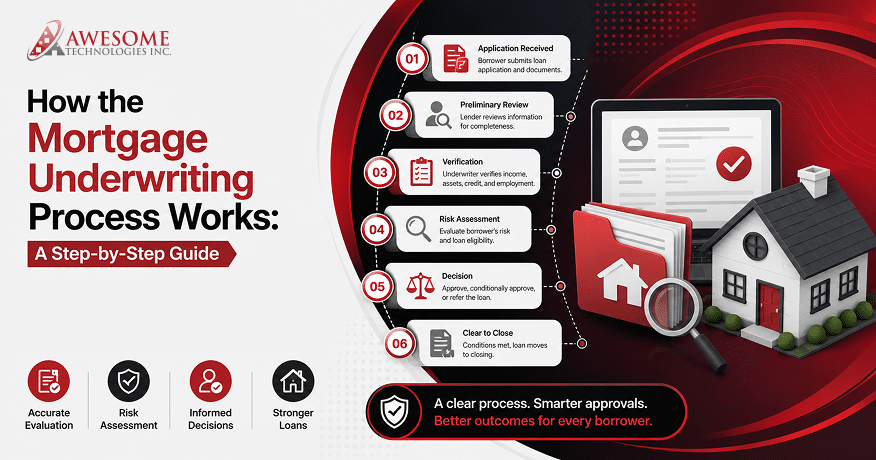
Loan Origination System is the primary document management system for all financial institutions. It manages validation of applicant profiles, application for Automated Underwriting Systems, arranging vendor services, conditional approvals and disclosures documentation.
| Pipeline Lifecycle | Key Operational Components | Primary Outputs |
| 1. Application Intake | The gathering of URLA (1003) information, uploading of documents, as well as light credit checks | Completed 1003 & initial borrower file |
| 2. Verification Engine | The process includes the automated voice verification and authentication, triple-merge process of handling credits while placing titled orders and achieving other service objectives. | The validators check the income and asset details and verify them against third-party information. |
| 3. Underwriting | The software makes decisions for DU by Fannie Mae and LPA by Freddie Mac with customized business rules. | Lender checks the underwriting decision made and conducts activities to meet loan conditions. |
| 4. Closing & Funding | The process involves the closing of the transaction along with the electronic signature collection. | Finally, the borrower signs the Closing Disclosure (CD). |
How Does the Digital Loan Origination System Work?
A mortgage loan origination system centralizes every stage of the lending process, from application intake to loan funding. Automated Loan Origination reduces manual work and processing time. It also improves workflow efficiency by automating repetitive lending tasks.
- Borrower Intake and POS Capture: All the critical data to fill the loan application is captured through the borrower portal of a loan application software. A mortgage POS provides borrowers with a secure digital portal to complete applications, upload documents, and track loan progress in real time.
- Verification Process: It involves an automated process that performs a credit check, verification of employment status, and flood hazard check using web-based API.
- Underwriting and Decisioning: Suggestions for underwriting are made using an automated process using DU or LPA, helping the lenders to provide conditional approval.
- Processing and Clearing Conditions: The automation system allows documents to be routed and alerts sent out to processors, underwriters, and borrowers about any missing documentation.
- Closing, Funding, and Delivery: This software creates the closing documents, receives e-signatures, generates e-notes, and sends approved loan documentation to investors.
Illustrative Implementation Example:
“For us, when implementing our automated LOS pipeline, we eliminated manual file transfers by calling webhooks directly. As a result, the duration for underwriting was reduced from 48 hours to less than 12 minutes for W-2.”
— Senior Financial Systems Architect, Top-50 Independent Mortgage Bank
Who Should Use Mortgage LOS Systems?
- Mortgage Lenders & IMBs: Independent Mortgage Bankers looking for quick volume and access to secondary markets.
- Commercial Banks & Retail Lenders: Many institutions also use commercial loan origination software to manage business lending alongside mortgage products. Organizations looking for solutions to support different products within mortgages, HELOCs, and commercial credits.
- Credit Unions: Financial organizations supporting their customers via smarter, user-friendly digital portals linked to a stronger compliance process.
- Mortgage Brokers: Wholesale mortgage brokers need mortgage broker software for fast pricing and loan comparisons.
Important thing to keep in mind: Small business loan origination software is ideal for community lenders with limited resources.
Benefits of Using top Loan Origination Systems
| Processing Methodology | Application Phase | Underwriting Phase | Closing Phase | Average Cycle Time |
| Legacy / Manual Model | 3 Days (Paper intake) | 7 Days (Manual clearing) | 14 Days (Physical docs) | 24+ Days |
| Modern Cloud LOS Model | 0.5 Days (Digital POS) | 2 Days (Automated AUS) | 3 Days (eClosing) | < 10 Days |
Modern mortgage systems simplify loan processing by connecting applications, underwriting, closing, and servicing on a single platform.
-
Faster Loan Processing
The manual entry of data could take more time for processing. Integration through the API will enable data processors to get access to the bank statements and tax returns. Hence, the normal processing time will be from 35 to 45 days, and it will be less than 15 days for automatic processes with a mortgage processing software. Many lenders are moving from spreadsheets to mortgage management software to remove manual tasks, improve collaboration, and reduce processing delays.
-
Automated Underwriting & Decisioning
Modern mortgage software systems combine basic rules of custom developed systems and standard AUS engines. In this way, workers can run Fannie Mae DU and Freddie Mac LPA processes virtually. As a result, on the initial phone call, the borrower will get pre-approval conditions via loan underwriting software. Loan Decisioning Software delivers quicker lending decisions. This helps lenders reduce turnaround times and improve the borrower experience. With artificial intelligence evolving rapidly in refining underwriting practices and decision-making, lenders have to understand responsible AI adoption for efficient and fair lending practices.
-
Better Borrower Experience
A Digital Mortgage Origination Platform creates a faster and more convenient borrower experience. Modern customers want a modern digital experience. Integrated user portals provide the opportunity to do everything on its own, like upload files or be informed about status via SMS.
-
Improved Compliance & Security
Mortgage lending must follow the regulations set by the CFPB, TRID, HMDA, and ECOA. With built-in features for compliance, automatic calculation of lender fees, conducting compliance checks in real-time, and keeping records even across time zones, lenders can reduce costly errors and audits.
-
Increased Operational Efficiency
Lenders complete more loans in less time due to an automated sorting process. Most lenders will process around 30 applications per month per process, while in traditional lending it could only be around 8-12 items a month.
Key Features to Look for in the Best Loan Origination Software
Understanding Loan Origination System Features helps you choose the right platform:
| Core Feature Architecture of Mortgage Loan Software | Operational Requirement & Impact |
| 1. Cloud-Native Infrastructure | Eliminates the need for maintaining the local server and provides fast updates regarding regulatory compliance. |
| 2. Open API Framework | Uses REST API and webhooks for synchronization of data in both the directions between external applications. |
| 3. Concurrent Multi-User Editing | Lets loan originators, processors, or underwriters to process files without record locking. |
| 4. Dynamic Business Rules Engine | Assigns the tasks automatically based on LTV ratio, credit score, or investors’ preferences. |
| 5. Integrated eClosing & EVault | Provides native e-notes, remote online notarization, and direct deposits to the investors. |
-
Loan Application Management
The mortgage origination system must include the latest changes in Uniform Residential Loan Application (URLA). The feature of intelligent forms creates different forms depending on what the applicant writes. So it will help to fill in the application and make fewer mistakes.
-
Workflow Automation
An ideal business rules engine automates tasks distribution. There are several factors that need to be taken into account while distributing tasks. These could be of different kinds: loan type, loan-to-value ratio, credit score, and others. This makes it easier and allows the loan process to continue without any gaps.
-
Document Management
The loan documentation software should include Advanced Document Recognition (ADR) with Optical Character Recognition (OCR). This will provide a chance to scan multi-page PDFs, separate tax statements, pay stubs, and other documents into relevant folders, and recover information such as income details.
-
Credit Bureau & Third-Party Integrations
The mortgage application software should integrate with the three major credit bureaus (Equifax, Experian, and TransUnion), verification providers such as The Work Number, flood vendors, title companies, and appraisal management companies (AMCs). With this solution, clients can use all of these services from the same platform without changing systems.
-
CRM & API Integrations
Modern loan processing relies on a connected technology system. REST APIs support loan software integrations by allowing Point of Sale (POS), CRM systems, and financial platforms to share data with each other in real time, removing the need for middleware. Hence, a Loan Originator Software improves productivity for lending teams.
-
Reporting & Analytics
Executive dashboards should showcase real-time performance about pipeline velocity, converting officers, and potential investor’s withdrawal risks. This gives managers a chance to solve possible problems faster.
-
Cloud-Based Deployment
A cloud-based loan origination software allows lenders to avoid the need to maintain their servers, benefit from automatic compliance updates, and work from anywhere and any device. Many financial institutions are also exploring why banks are upgrading legacy mortgage lending software to improve scalability and simplify technology management.
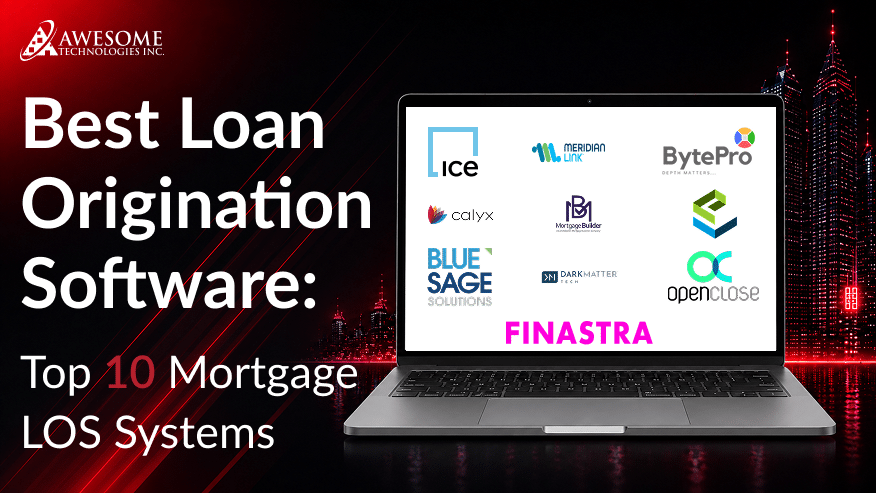
Top 10 Best Mortgage LOS Systems
Let’s explore a detailed review of the ten leading Loan processing software systems used in the mortgage lending sector.
| Platform | Market Positioning & Core Focus | Deployment Type |
| 1. ICE Encompass | Enterprise-grade solution for large-scale lenders and IMBs | Hybrid / Cloud |
| 2. MeridianLink | Ideal for any credit unions or banks looking for cross-product functionality | Cloud SaaS |
| 3. BytePro | Highly adaptable workflow engine for mid-sized mortgage bankers | Cloud / On-Prem |
| 4. Calyx Point | Proven and trusted option for banks and brokers | On-Prem / Cloud |
| 5. OpenClose | Browser-based SaaS LOS complementing the POS systems | Cloud SaaS |
| 6. Mortgage Builder | Detailed loan origination and servicing for retail lending | Cloud-Hosted |
| 7. LendingPad | Cloud mobile software created for real-time service | Cloud Native |
| 8. Blue Sage | Cloud-native, AI-driven digital mortgage platform for end-to-end mortgage lending. | 100% Cloud-Native (SaaS) |
| 9. Dark Matter Empower | Enterprise-grade platform focusing on automated, exception-based processing and AI. | Cloud-Based SaaS |
| 10. Finastra Mortgagebot | Turnkey, simple mortgage suite integrated directly with core banking. | Hosted SaaS / Cloud |
The following Loan Origination System examples highlight leading platforms in the mortgage industry.
ICE Encompass
Overview
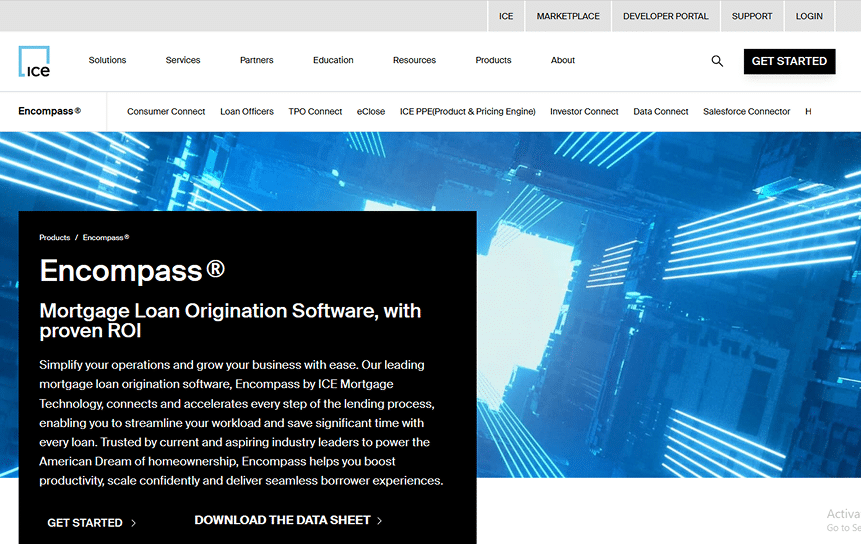
Encompass by ICE is the main product for large mortgage lenders. It manages the entire loan lifecycle from customer intake to secondary market trading and investor delivery within a single unified database.
| Layer | Architecture Component | Functional Role |
| Front-End | Consumer Connect (POS) | Borrower intake and document upload facility |
| Core Database | Encompass Processing Engine | System of records for validation and rule management |
| Services | Developer Connect & Compliance | REST API, AUS trigger, online audit engine |
| Secondary | Secondary Partner Connect | Lock desk and investor delivery for secondary market |
Key Features
- Compliance Service Engine: Executes continuous background checks for federal regulations
- Developer Connect: Open RESTful API for integration of platform usages
- Encompass Consumer Connect: Branded portal for applicants
- Secondary Partner Connect: Direct link with the heavy secondary investor market
Organizations can further improve productivity by exploring the latest AI integrations for Encompass automation, document processing, and workflow optimization.
Pros & Cons
- Pros: Complete end-to-end loan management within a user-friendly borrower portal.
- Cons: High total cost and demands for administrators
Pricing
Custom enterprise costing based on closed loan volume
Best For
Large Independent Mortgage Banks (IMBs), enterprise lenders, and high-volume financial institutions need this mortgage lending system.
MeridianLink
Overview
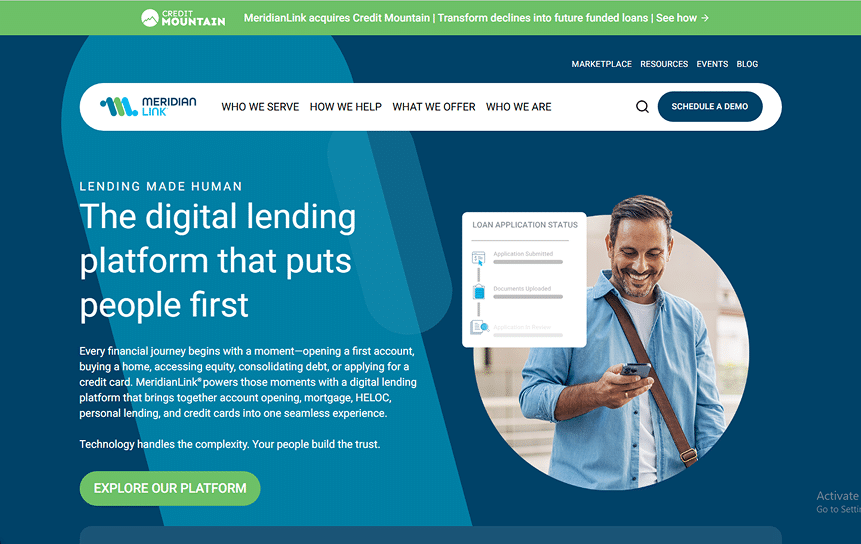
MeridianLink Mortgage is the complete Bank Loan Origination Software used by banks with a variety of loan portfolios that goes beyond typical mortgage loans.
| Module | Loan Types Managed | Operational Capability |
| Mortgage Module | Conventional, FHA, VA, USDA | Complete digital origination as well as compliance systems |
| Consumer Module | Auto, Personal Loans, Credit Cards | Cross-selling prompts using basic information |
| Equity Module | HELOCs, Home Equity Loans | Single account setup and underwriting |
Key Features
- Multi-Product Engine: Enables you to generate mortgages, car loans, personal loans, and home equity lines of credit using just one platform.
- Cross-Sell Engine: Automatically assesses the data provided by loan applicants and presents additional lending options right during the application process.
- MeridianLink Portal: Combines easy online account creation with efficient application intake.
Pros & Cons
- Pros: The main strength of this loan software for lenders is that it has a single database to access both loans and mortgages, which makes it perfect for the credit union sector.
- Cons: The interface is rather complex; customization requires third-party assistance.
Pricing
Custom subscription and volume-based pricing model.
Best For
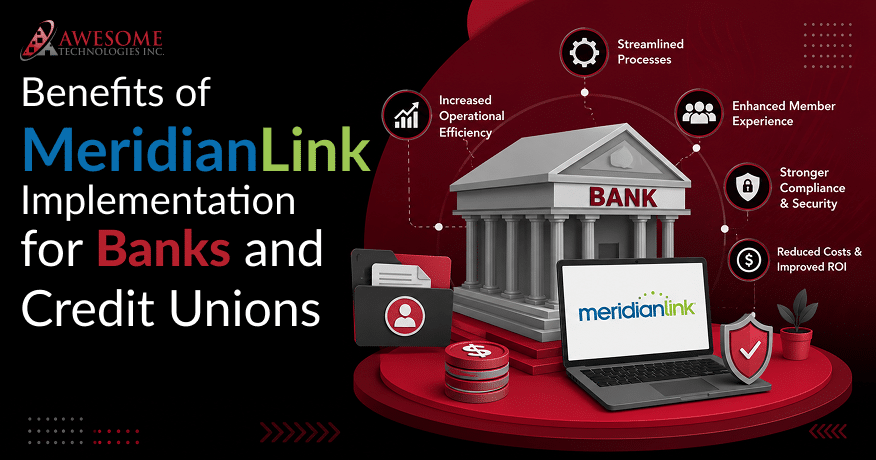
Banks and finance institutions that prefer to manage consumer finance and mortgages through one platform. Learn how a successful MeridianLink implementation for banks and credit unions can improve operational efficiency, automate workflows, and enhance the borrower experience.
BytePro
Overview
BytePro is a flexible, configurable Loan Origination System widely used by mid-sized mortgage bankers and brokers who require brief control over operational workflows.
| Structural Component | Operational Function |
| Custom Screen Builder | Role-based information field arrangements and customized data input screens |
| Macro Automation Engine | Custom event chains activated by changes in specific fields or updates in status |
| Validation Framework | Stops the progress of files if compliance needs or significant fields fail |
Key Features
- Custom Screen Builder: Customize the information fields and layout views for specific teams every time.
- Macro Automation: Create the automated events in dependence on the defined updates in specific fields.
- Validation Engine: Stops the file movement if certain compliance fields do not pass the control.
Pros & Cons
- Pros: Much flexible in comparison to Encompass, has low administrative costs, fast response.
- Cons: User interface is rather old, needs strict implementation to avoid unnecessary files in the system.
Pricing
Monthly fees per person or pricing based on volume.
Best For
Companies and organizations dealing with middle-size mortgage banking, regional credit unions, and brokers who require operations suitable for their needs.
Calyx Point
Overview
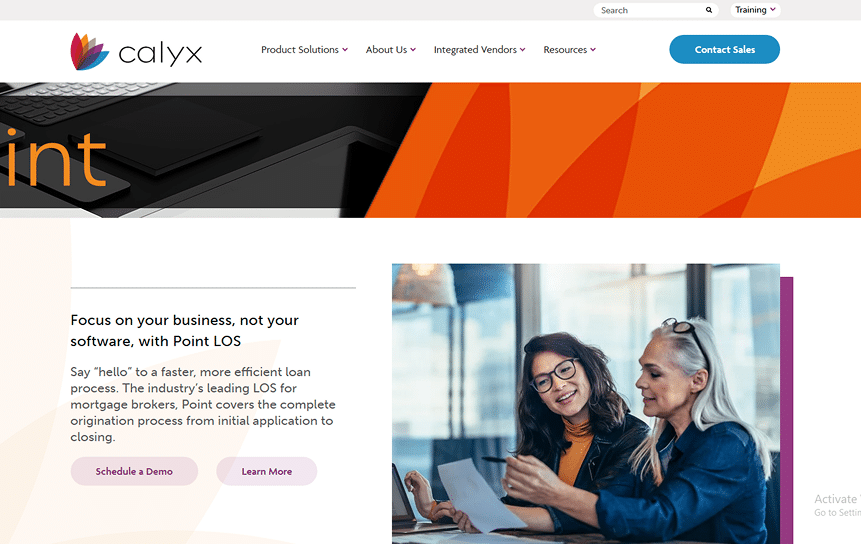
Calyx Point is one of the most established names in mortgage technology, offering a stable and reliable LOS platform tailored for small to mid-sized mortgage brokers and community lenders.
| Ecosystem Tool | Primary Purpose |
| Point POS | Borrower application capture and document uploads |
| Zip Portal | Borrower communication and status tracking |
| InPointe | TRID tolerance monitoring and compliance checks |
Key Features
- Zip Borrower Portal: This is an easy-to-use digital platform for borrower application submission.
- InPointe Compliance: Built-in compliance checking and TRID monitoring tools.
- Wholesale Investor Export: An easy way to submit loans through wholesale investors.
Pros & Cons
- Pros: An industry standard platform for small scale mortgage brokering and easy platform to learn how to use.
- Cons: Not as effective for complex users and larger enterprises.
Pricing
Affordable pricing options per user.
Best For
Independent mortgage brokers, boutique lenders, and small community banks.
OpenClose
Overview
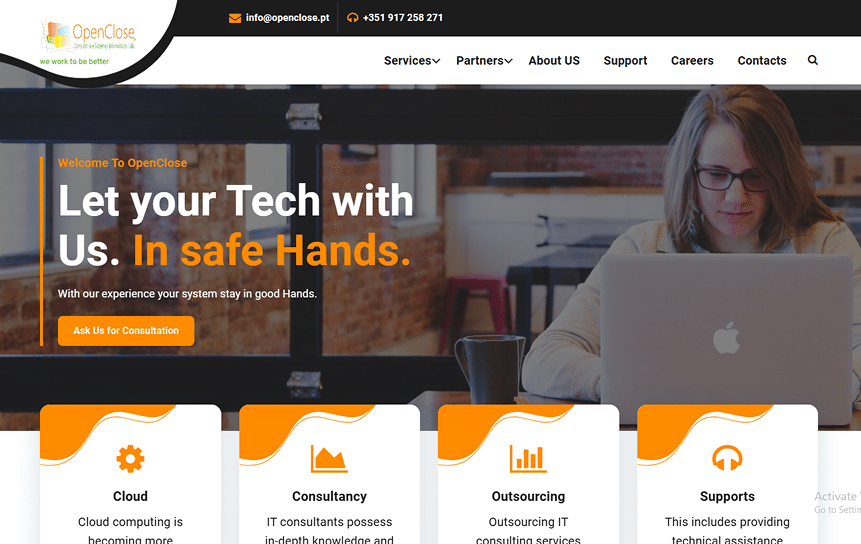
OpenClose provides a native web-based SaaS LOS designed for rapid deployment, low infrastructure maintenance, and easy point-of-sale integration.
| System Layer | Functional Feature | Operational Value |
| Intake Portal | Web POS Portal | Direct applicant data capture and upload |
| Pricing Module | LenderAsk PPE | Native pricing and eligibility from the system |
| Core Processing | Cloud LOS Engine | Web SaaS without local installations |
Key Features
- LenderAsk PPE Integration: This is a fully integrated pricing and eligibility engine.
- Web-Native SaaS: Built for the web from the start and allows no localized installations.
- Restful API Layer: Allows easy connection to the latest fintechs.
Pros & Cons
- Pros: Fast implementation time, the system has an inbuilt pricing engine, requires a small initial investment.
- Cons: Not as many customized enterprise options like traditional systems.
Pricing
Tiered subscription pricing based on the number of users and number of active pipelines.
Best For
Community banks and independent mortgage companies looking for a browser-based solution.
Mortgage Builder
Overview
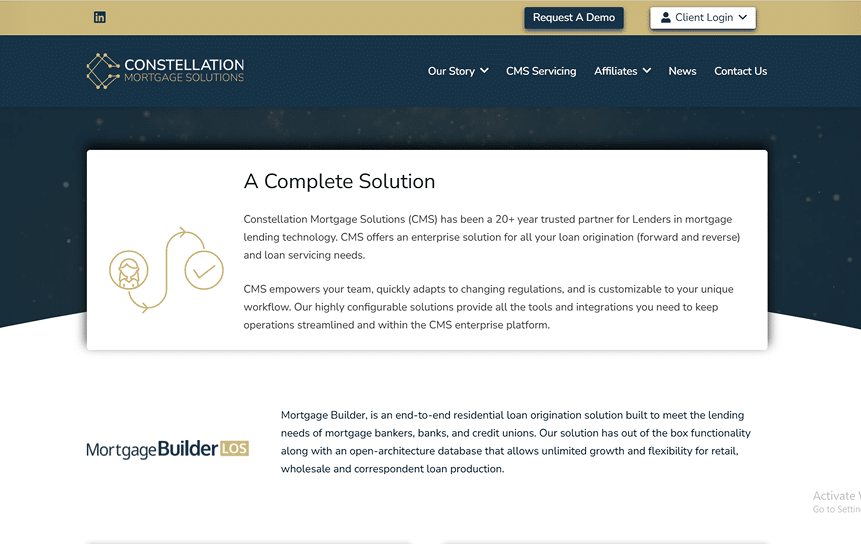
Mortgage Builder is one of the best end-to-end loan origination platforms that provides processes for both loan origination (LOS) and loan servicing (LSS). It is used by both retail and wholesale mortgage companies.
Key Features
- Origination to Servicing: There is a smooth changeover between the loan originating process and temporary without the need for data input in between.
- Customizable Pipeline Views: Have the option of customizing loan administration queues according to the professional responsibilities.
- Integrated Secondary Marketing: All important tools are available for operating lock desks, pricing, and making commitments.
Pros & Cons
- Pros: Reliable customer service and great combination of loan management and servicing.
- Cons: Slower integration cycle for third-party tools outside their ecosystem.
Pricing
Custom enterprise quote based on annual loan volume.
Best For
Companies involved in the mortgage business, particularly those that operate in the medium market segment.
LendingPad
Overview
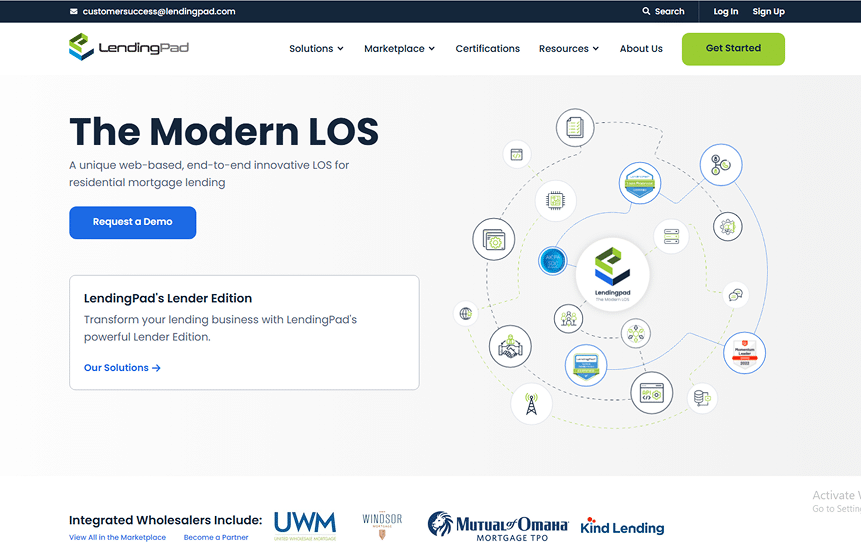
LendingPad is a fully cloud-based loan origination system designed to let multiple users work on the same loan file at the same time without record locking.
| User Role | Simultaneous Capabilities | System Response |
| Loan Officer | Updates on income and application specifications. | Changes appear immediately on all devices |
| Processor | Orders payment checks and title documents | File remains active even when working with vendor APIs |
| Underwriter | Removes decisions from credit checks and refreshes approval status | Zero file locking or overwritten data |
Key Features
- Real-Time Multi-User Collaboration: Loans in any state can be worked on by multiple people at the same time without generating any overwrite errors.
- Cloud Architecture: Instant web deployment with no requirement for installation or maintenance.
- End-to-End Wholesale Connectivity: Data synchronization in real-time with leading wholesale lenders.
Pros & Cons
- Pros: Quick processing speed, easy solution of file locking issues, modern interface
- Cons: Reporting features need to be set up for a smart enterprise analysis.
Pricing
Transparent monthly seat-based pricing plans (Broker, Lender, and Enterprise tiers).
Best For
Growing mortgage brokers, non-delegated lenders, and digital-first lending teams.
Blue Sage
Overview
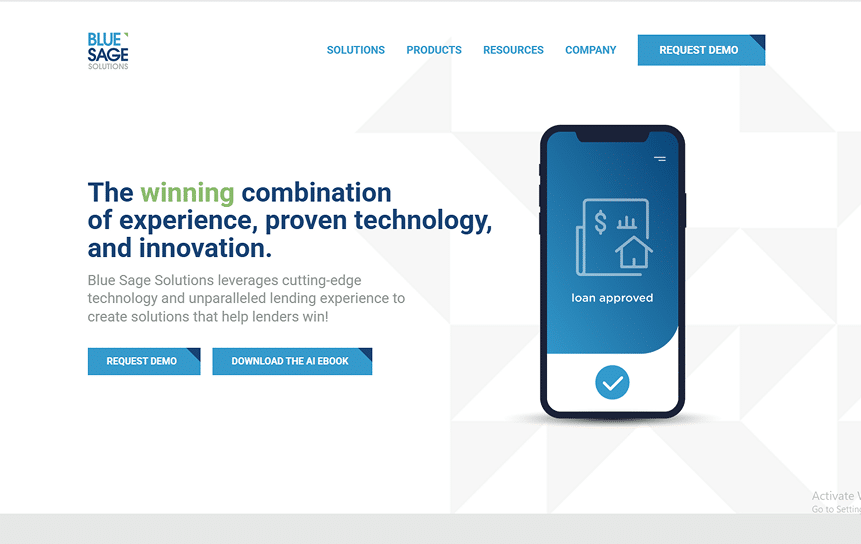
Blue Sage Solutions is a state-of-the-art cloud-native Digital Lending Platform and Digital Servicing Platform. It facilitates the entire loan cycle from point-of-sale application to post-closing, secondary marketing, and provisional servicing.
Key Features
- Unified POS & LOS Architecture: Done away with the divide between systems used by the borrower, the loan officer, and the back office.
- Cloud-Native Microservices: Providing software solutions based on cloud computing technology (AWS).
- Digital Servicing Platform (DSP): An intermediary servicing solution built per MISMO standards.
- Automated Workflow & Compliance Engine: The APPS Engine checks rules in real time, allows for automatic distribution of tasks, and controls their performance.
- Open API Marketplace: RESTful APIs for third-party integrations (credit, automated underwriting systems, doc preparation, title).
Pros & Cons
- Pros: No legacy tech debt, end-to-end coverage, high scalability
- Cons: Smaller market footprint, ecosystem size, change management
Pricing
A subscription plan is based on Software as a Service (SaaS) combined with a plan that charges for closed loans.
Best For
Mid-market to enterprise Independent Mortgage Bankers (IMBs), credit unions, and banks
Dark Matter Empower
Overview
Empower is an enterprise-level LOS for high-volume mortgages. It utilizes deep automation, AI, and an open AI agent framework to update complex workflows.
Key Features
- Aiva Automation & AI Layer: Intelligent document classification, automated income calculations, and post-close quality reviews.
- Model Context Protocol (MCP) AI Framework: Easy access to AI in the loan origination system in a safe way;
- Dynamic Tasking Engine: Introduces dynamic condition-based triggers for replacing fixed milestone tasks.
- Deep Verification Integrations: Smooth integration with VOI/VOE data sources (Truv, The Work Number) and Fannie Mae Day 1 Certainty®.
- Role-Based POS & Portal: Specific user interfaces designed for borrowers, loan officers, underwriters, and closers.
Pros & Cons
Pros: Enterprise level proven technology, AI Automation, Speed to Close
Cons: Expensive implementation, complex, resource intensive
Pricing
Custom pricing based on annual loan volume, with enterprise licensing, setup, and implementation fees.
Best For
Large enterprise-level lenders, mega banks, top-tier IMBs, and other financial organizations
Finastra Mortgagebot
Overview
Finastra Mortgagebot is a popular, web-based loan origination software made of MortgagebotPOS and MortgagebotLOS. It works as a turnkey digital mortgage solution for lending professionals in banks and credit unions.
Key Features
- MortgagebotPOS: Web-based 1003 application capture complete with PPE (Product and Pricing Engine) functionality for quick approvals.
- MortgagebotLOS: 100% browser-based pipeline management system with functionality for processing, underwriting, and post-closing.
- LaserPro Integration: Direct integration with Finastra’s LaserPro loan document generation system.
- Automated Compliance Maintenance: Delivers regulatory changes directly to the cloud without any local IT installations.
- Turnkey Implementation: Configurable deployment for quick implementation (typically in less than 90 days).
Pros & Cons
Pros: Quick launch, high online conversion rate, turnkey compliance
Cons: UI/UX, limited customization
Pricing
Flexible monthly or annual SaaS pricing based on loan volume, users, or assets, with low upfront setup costs.
Best For
Community banks, regional banks, and credit unions
Loan Origination Platforms’ Comparison Table
Use this Loan Origination Software Comparison to evaluate features, pricing, and deployment options. The table also provides insights into Loan Origination Software Pricing to help you make an informed decision.
| Software | Best For | Deployment | Key Integrations | Pricing Model | Rating |
| ICE Encompass | High-Volume Enterprise IMBs | Hybrid / Cloud | DU/LPA, All Major | Custom Enterprise | 4.8 / 5 |
| MeridianLink | Banks & Credit Unions | Cloud SaaS | Core Banking, AUS | Custom Quote | 4.6 / 5 |
| BytePro | Mid-Market Lenders & IMBs | Cloud / On-Prem | Credit, Title, PPE | Per User / Loan | 4.5 / 5 |
| Calyx Point | Brokers & Boutique Lenders | On-Prem / Cloud | Credit, Zip POS | Per User Seat | 4.2 / 5 |
| OpenClose | Community Banks & Lenders | Cloud SaaS | Native PPE, AUS | Monthly SaaS | 4.4 / 5 |
| Mortgage Builder | Retail & Interim Servicing | Cloud-Hosted | PPE, Credit, Docs | Volume-Based | 4.3 / 5 |
| LendingPad | Fast Multi-User Teams | Cloud Native | Investor APIs, PPE | Monthly Per Seat | 4.9 / 5 |
| Blue Sage | Independent Mortgage Banks (IMBs), credit unions, and retail/wholesale lenders | 100% SaaS (Cloud-Native) | AUS, PPE, eSign & Docs, credit & data | Base platform subscription + per-closed-loan fee | 4.5/5 |
| Dark Matter Empower | Large enterprise lenders, tier-1 mortgage banks, and mega-credit unions | Managed Enterprise SaaS / Cloud | AI & automation, verification and compliance, GSE & Core | Annual tiered contracts based on total origination volume + implementation) | 4.7/5 |
| Finastra Mortgagebot | Community banks, regional credit unions, and financial institutions | Hosted SaaS (Cloud) | Ecosystem, core banking, fintech services | Quote-based based on asset size, channel selection, or active seat counts | 4.2/5 |
How to Choose the Right Mortgage Lending Software?
The choice of Mortgage Platform Software should be in line with the particular institutional model:
| Institution Type | Primary Operational Need | Recommended Software Focus |
| Mortgage Broker (1-15 Seats) | Rapid implementation, affordable cost per user, and no file lock-ups | LendingPad or Calyx Point |
| Credit Union / Bank | Integration with core banking system and support for several products. | MeridianLink or OpenClose |
| High-Volume IMB (500+ Loans/mo) | Wide range of connections with investors and automatic conformance. | ICE Encompass or BytePro |
| Fintech / Specialty Lender | Ability to use custom API and implement personalized underwriting processes. | MeridianLink |
For Mortgage Lenders & Independent Mortgage Bankers (IMBs)
It is important to choose a mortgage system that has good catalogs available on the secondary market, has the important integration with the pricing engine, and can automatically deliver the information to investors.
For Banks
Loan Origination Software for banks supports enterprise lending operations and regulatory compliance. It should have core-banking compatibility, while following tough security regulations. In this field, MeridianLink stands out because this loan software for banks allows for the integration of home mortgage and commercial/retail banking solutions.
For Credit Unions
It is necessary to focus on the experience of users and members on the portals. Your members require easy digital applications. Go for those platforms that give automated pre-approval and can sell auto loans or personal lines of credit as well.
For Mortgage Brokers
Loan Origination Software for Mortgage Brokers simplifies wholesale loan processing and lender submissions. The choice is made based on the target price per seat, fast start-up times, and real multi-user access. LendingPad and Calyx Point are the leaders in the industry, making them the best option for wholesale packaging and submissions.
For Enterprise Lending Teams
Make sure to have good open APIs, the possibility of customizing business rules, and the ability to audit in real time. The platform must be able to execute database requests to avoid slowdown during the end-of-month processing.
Loan Origination Software vs. Mortgage LOS Systems
Understanding the difference between broad lending platforms and specialized mortgage engines helps ensure you purchase the right system:
| Evaluation Metric | Generic Loan Origination System | Specialized Mortgage LOS Engine |
| Data Schema Support | Designed specifically for unsecured and personal loans | Native support for MISMO data standards & URLA (1003) |
| Underwriting Connections | Simple rules engine and basic credit report requests | Detailed integration with Fannie Mae DU and Freddie Mac LPA |
| Compliance Engines | Primary checks for privacy and state regulation | TRID fee tolerances, LE/CD guidelines and HMDA reporting included |
| Secondary Market Tools | Standard flat interest metrics | Active operation of second lock desks, investor delivery and MERS tracing |
Key Differences
- Data Standards: Mortgage LOS applications have built-in MISMO data standards and predefined URLA (1003) application form fields, while general-purpose loan software can only provide customized data structures.
- Compliance Checks: Mortgage applications routinely check TRID 3-day period disclosures, LE/CD fee tolerances, and HMDA compliance.
- Secondary Market Delivery: Mortgage applications come with integrated locking agent technology, direct access to automated underwriting systems, and investor delivery systems.
Which One is Right for Your Business?
If you are in the business of issuing mortgage loans that are monitored by the CFPB, you should use a specialized mortgage LOS. In comparison, if your company primarily provides a range of short-term loans, in addition to personal lines and specialized leasing for equipment, you can benefit from greater freedom of operation by using a generic LOS. In all these scenarios, picking one of the best loan origination software vendors is crucial.
Real-World Case Study: Accelerating Processing Speed (An Illustrative Example)
| Transformation Metric | Pre-Implementation (Legacy System) | Post-Implementation (Cloud LOS) | Operational Impact |
| Average Loan Cycle Time | 42 Days | 14 Days | 66% Reduction in cycle velocity |
| Manufacturing Cost / Loan | $11,800 per closed file | $7,788 per closed file | 34% Reduction in processing costs |
| Processor Throughput | 8 closed loans / processor / month | 22 closed loans / processor / month | 175% Increase in team capacity |
For a medium-size regional bank processing $40M in transactions per month, it was difficult to cope with a cycle time of 42 days on a legacy desktop LOS system. Processors wasted hours of work every day because of problems of file locking when the underwriters could not access the file while the loan officers were adding comments to the file.
As a result of migration to a cloud LOS that allowed working on one file at the same time for loan officers, underwriters, and processors, the team managed to reduce the cycle time to 14 days in four months thanks to automated asset verification webhooks. In fact, a loan originator software helped decrease transaction costs by 34%.
Practical Implementation Step-by-Step Checklist
Utilizing mortgage loan origination best practices will help lenders improve their implementations and comply with the necessary regulations.
| Deployment Phase | Timeline | Operational Actions & Deliverables |
| Phase 1: Workflow & Data Mapping | Weeks 1–3 | Map all loan manufacturing process flows; audit integrations between credit, title, and POS systems |
| Phase 2: Sandbox & API Configuration | Weeks 4–7 | Customize rules, permissions, and automated webhooks for assets |
| Phase 3: Super-User Pilot Testing | Weeks 8–10 | Test processing 20 live files within pilot branch; check for TRID tolerances and AUS speeds |
| Phase 4: Full Enterprise Rollout | Weeks 11–12 | Train roles, cut over database, and archive legacy files |
- Phase 1: Workflow & Data Mapping (Weeks 1–3)
- Map all existing loan manufacturing process flows from start to delivery of the loan by investors.
- Audit all third-party vendor connections (credit, pricing engine, title, flood, eSign).
- Phase 2: Sandbox Setup & Configuration (Weeks 4–7)
- Customize your business rules and field validations, set up users’ permission groups.
- Create webhooks for automated asset verifications, soft credit pulls, and CRM integration.
- Phase 3: Super-User Pilot Testing (Weeks 8–10)
- Route 20 live loan applications to your designated pilot branch.
- Audit compliance disclosures, TRID tolerances, and AUS execution speeds.
- Phase 4: Full Enterprise Rollout & Training (Weeks 11–12)
- Schedule training for Loan Officers, Processors, Underwriters, and Closers.
- Cut over the database, archive legacy files, migrate the live pipeline management.
Why Choose Awesome Technologies Inc.?
Modern Loan Origination System Software helps lenders automate workflows, maintain compliance, and improve operational efficiency. Making the switch to a different LOS or adjusting a current enterprise configuration can be complex. Awesome Technologies Inc. assists mortgage companies in the digital mortgage transformation while ensuring that operations stay smooth.
| Specialized Service | Core Capabilities & Deliverables |
| Custom Software Development | Custom-designed points-of-sale (POS) portals, document intake systems, unique reports |
| LOS Implementation & Integration | Full-system migrations, interface linking to credit bureau, title, PPE and banking APIs |
| Mortgage Workflow Automation | Customized scripting to enforce business rules, automated document recognition (ADR), APIs |
| Ongoing Support & Optimization | Pure system admin, regulation rule updates, system configuration |
-
Custom Mortgage Software Development
If you are not satisfied with your off-the-shelf solution and find yourself wanting more, our development team can provide custom point-of-sale interfaces, automated document intake modules, and specific reporting dashboards designed with your needs in mind.
-
LOS Implementation & Integration
Don’t waste time dealing with deployment issues and lost data connections. We will perform end-to-end LOS migration and integrate your new platform with credit bureaus, title companies, pricing engines, and enterprise core banking systems.
-
Mortgage Workflow Automation
Our experts create custom business logic, set up automated document recognition triggers, and establish API webhooks to prevent data entry bottlenecks and smooth out loan processing.
-
Ongoing Support & Optimization
System maintenance is an ongoing process. Awesome Technologies Inc. can provide you with system administration services and regular performance tuning.
Final Thoughts
The mortgage lending landscape is changing fast. Lenders using out-of-date systems will incur extremely high cost of doing business with awkward processes, regulatory risks and delayed processing times. Leading Loan Origination Software Vendors offer solutions tailored to different lender sizes, workflows, and compliance requirements.
Migration to cloud-based Mortgage Loan processing software solutions can give your company the tools needed to be successful under any conditions. It is wiser to review loan processing platforms according to the amount of your loans, structure of your institution, as well as technology needs. So look for mortgage lending systems which have good integration through open APIs and powerful automation tools.
Looking to build custom mortgage software or modernize your lending technology? Awesome Technologies Inc. develops mortgage POS portals, LOS integrations, workflow automation, and custom lending solutions tailored to your business needs. Contact us to discuss your project.
Frequently Asked Questions
1. What is loan origination software?
Loan origination software automates and manages the entire lifecycle of a loan, from initial application intake and credit checks through underwriting, closing, funding, and secondary market delivery.
2. What is a loan origination system (LOS)?
A Loan Origination System (LOS) serves as the core system of record for financial institutions, enforcing compliance rules, holding applicant data, executing automated underwriting checks, and orchestrating closing disclosures.
3. What is the best mortgage loan origination software?
The best loan software programs depend on your operational model. ICE Encompass is popular for high-volume enterprise lenders, MeridianLink is ideal for credit unions, and LendingPad is widely favored by brokers and fast-growing digital teams as it has real-time collaboration features. Reviewing a List of Loan Origination Systems can help you compare platforms based on your lending requirements.
4. How much does loan origination software cost?
Pricing models vary widely. Seat-based SaaS systems range from $70 to $250+ per user per month, while enterprise systems charge volume-based fees ranging from $15 to $60+ per closed loan file, plus implementation and setup costs.
5. How long does LOS implementation take?
Cloud-native platforms like LendingPad or OpenClose can be deployed in 2 to 6 weeks. Complex enterprise installations like ICE Encompass typically take 3 to 9 months for full data mapping, rule building, and integration testing.
6. Can loan origination software integrate with CRM and banking systems?
Yes. Modern platforms provide open REST APIs and webhooks that enable direct bi-directional data syncing between your LOS, CRMs (like Salesforce or HubSpot), Mortgage POS software portals, and core banking platforms.
7. Is cloud-based loan origination software better than on-premises?
Cloud-native platforms generally offer better accessibility, higher uptime, instant compliance updates, and updated API integrations without requiring local IT server maintenance.
8. What features should I look for in a mortgage LOS?
Look for automated underwriting connections (DU/LPA), automated verification APIs, dynamic business rules, eSigning/eClosing support, TRID compliance tracking, and open API connectivity.