
Despite the fact that purchasing a house can bring many positive impacts, it should be taken into account that once you send your application for a mortgage, you are also going to experience some stress in this period of time. This happens due to the fact that the period of underwriting may be long enough to worry about one’s application. Nevertheless, there may be no need to worry so much. For example, a first-time home buyer was checking her application status for two weeks as the application was still with the underwriters and decided to make a phone call to her mortgage broker.
Once she called him, she believed that her loan application would definitely be rejected. The thing is that the underwriter has a lot of work as he/she needs to review many difficult papers related to self-employment taxes and process many other applications as well. The knowledge of the underwriting process is crucial for forming reasonable expectations and avoiding unnecessary worries about the status of the application. Thus, it is extremely important to understand the main aspects of the underwriting process such as its duration and the list of documents needed for getting a loan, mortgage underwriting process step by step and what happens during mortgage underwriting.
In this mortgage underwriting guide, we will discuss mortgage underwriting steps, the duration of the process, challenges, and benefits in detail.
What is Mortgage Underwriting For First-time Home Buyers?
The mortgage underwriting process is the stage in which a lender reviews a borrower’s financial profile, credit history, income, assets, and overall risk to determine whether they qualify for a mortgage loan.
Despite the fact that much of the mortgage approval underwriting has become computerized, the task of the loan underwriter remains extremely important since he/she deals with a range of papers and performs a set of activities that cannot be performed automatically.
The Four Cs Underwriters Actually Evaluate
Each mortgage application depends on four key lending standards referred to as Four Cs that provide a holistic view of one’s financial position and ability to repay the loan.
| Categories | What It Measures? | What Underwriters Look At? |
| Credit | Your payment record | Credit history, credit score, debts, and credit utilization |
| Capacity | Possibility of paying debts | Income, employment record, expenses, and debt to income ratio |
| Capital | Your financial resources | Savings, bank balance, sources of income, down payment, and cash available |
| Collateral | Whether the asset justifies loan estimate/size | Property evaluation, condition of the property, property appraisal, sales of comparable properties, and whether the property is worth the requested amount |
The areas should be analyzed to identify the possibility of providing the loan under acceptable risks.
For instance:
- Credit speaks about the way you handled borrowed money in the past.
- Capacity shows whether you can afford one more payment with your current income.
- Capital reflects your financial stability and ability to handle any additional expenses after completing the deal.
- Collateral gives security for the mortgage lender due to the fact that market price of the property covers its loan amount.
It is worth mentioning that the method matches the recommendations of major mortgage lenders such as Wells Fargo which focus on the necessity to analyze credit history, income, and assets of the borrower.
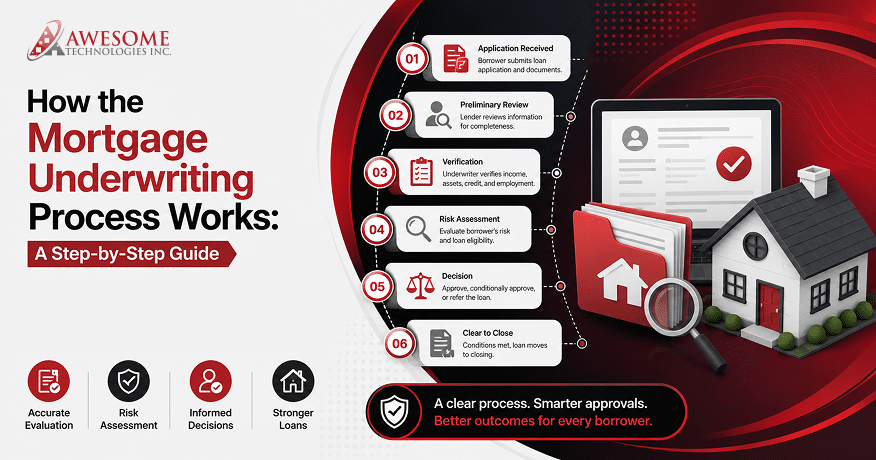
Mortgage Underwriting Process Step by Step: How the Loan Review Unfolds?
Thinking about how the mortgage underwriting process works? Let’s explore each step one by one for better understanding.
Step 1: Your Loan File Is Sent to Underwriting
Once you have submitted all the required mortgage documents, the loan processor will go through the file to ensure that there are no missing items. Upon completion of all the requirements, the processor sends your application to the underwriting department for evaluation. This process usually takes about one or two working days after the submission of all the documents.
Whereas you still deal with the loan officer as your point of contact during the entire process, the underwriter is the person who will be reviewing your financial data and evaluating the application according to the approval guidelines of the lender.
Step 2: Automated Underwriting Reviews the Application
Most lenders use Automated Underwriting Systems (AUS) to define the initial outcome of your application based on the information provided against the lending criteria set out by agencies and investors.
Such a system gives an initial suggestion whether the application will be approved, referred to manual underwriting or will need further documentation. Although the use of automation allows quick assessment of the application, it does not always result in a final decision being made. Currently, a number of lenders are utilizing AI to enhance accuracy in the process of underwriting, automate the procedure of document verification, identify fraud, and hasten the process of getting loans approved. Read further to learn how AI in mortgage underwriting is transforming the process effectively.
An automated system works only with the data it receives and requires all the information to be accurate and complete. In case of missing, incorrect data, the system may need additional documentation to be submitted and problems to be investigated. According to reviews of mortgage professionals on TrustRadius, an update of the Uniform Residential Loan Application might increase the necessity of manual review as well.
Step 3: Manual Underwriting and Document Verification
After the automated process is finished, the loan officer will personally go through your application and other documents that you submitted. This step will help to make sure that all information is correct and meets the requirements set by the underwriting department of the lender.
Mortgage Underwriting Checklist:
- Proof of income
- Tax documents and W-2 forms
- Bank statements
- Employment information
- Credit report
- Current liabilities and other obligations
Step 4: Property, Title, and Financial Reviews Continue
In addition to evaluating your finances, the lender does other important things while reviewing your financial information when it comes to mortgage underwriting after appraisal. These include appraising your home to ensure its true market value and searching for your title to look for any ownership or legal concerns that may arise.
In the meantime, your underwriter reviews other aspects of your finances. It includes your income, assets, tax history, credit score, debts, and any other items that might come up from the automatic mortgage underwriting review.
Step 5: Conditional Loan Approval
Receiving a conditional approval is a positive sign. It means the underwriter is generally satisfied with your application but needs a few additional items before issuing final mortgage approval.
It’s uncommon for a mortgage file to be approved without any follow-up requests. In most cases, borrowers are asked to provide additional documentation, such as:
- Updated bank statements
- A letter explaining a large deposit
- Documentation showing a debt has been paid off
- Additional proof of income or assets (could be asset verification as a process)
Straightforward applications may receive underwriting decisions within one business day, while more complex files involving self-employment income, multiple assets, or unique financial situations typically require additional review time.
Pro Tip: Don’t be alarmed if your conditional approval includes several outstanding requirements. Underwriters usually organize these requests into two separate categories:
Prior-to-Document (PTD) Conditions
These items must be completed before the lender prepares your final closing documents. Examples include updated pay stubs, IRS tax transcripts, employment verification, or other supporting financial records.
Prior-to-Funding (PTF) Conditions
These requirements must be satisfied before the lender releases the loan funds. Common examples include obtaining homeowners insurance, completing final quality-control checks, or meeting any remaining closing requirements.
Step 6: Clearing the Remaining Conditions
Mortgage Underwriting Before Closing focuses on clearing any remaining conditions. Once the loan is conditionally approved, the loan processor collects all necessary documents and again sends it back to underwriting for one last time. Only after satisfying all conditions, the loan is finally approved by the underwriter.
To prevent any kind of delay, it is advisable to submit all required documents within 48 hours from conditional approval according to Wells Fargo.
A pre-closing employment verification is done by many lenders to make sure that there have been no changes in your financial status. This can either be done via your employer or through a certified third party.
If you have had a recent job change or have moved industries and have decreased your work hours and so your income level, then the lender might ask for some further documents or consider your application for the loan.
Step 7: Clear to Close
When all underwriting requirements have been fulfilled, the lender releases a Clear to Close (CTC), which means that the mortgage approval process is complete, and your mortgage is ready for closing. On that stage, you will be provided with a Closing Disclosure containing information on your loan terms, including the amount you will pay monthly and interest rate and closing costs. According to federal regulations, a borrower should get this document at least three days prior to the closing date.
Step 8: Mortgage Closing
The closing stage is the last stage of the mortgage process. During the closing process, you will sign necessary documents, money will be disbursed by the lender, and the title to the property will pass on to you. After closing, your mortgage will enter the servicing stage, and you will start paying your monthly mortgage according to your mortgage contract terms.
How Long Does Mortgage Underwriting Take?
“What will be the duration of the underwriting process?” is one of the most common questions asked by borrowers. The time taken will vary based on the complexity of the mortgage being undertaken and the speed at which the documentation process is completed.
The ICE Mortgage Technology Origination Insight Report (2025), for instance, indicates that the average purchase mortgage takes about 42 days between application and funding. Since underwriting is just part of the mortgage process, the process usually takes up some of that time.
| Loan Scenario | Estimated Mortgage Underwriting Timeline |
| W-2 employee with stable income, strong credit, and a standard property | 3–7 business days |
| Self-employed borrower, multiple income streams, or credit challenges | 10–14 business days |
| Average purchase loan from application to closing (2026 industry average) | About 42 days |
Just remember that all these numbers can change due to the level of the lender’s workload and seasonal demand. During times when there is increased demand for home purchases, there will be a huge number of files processed by the underwriting department, thus prolonging the time needed for the process.
According to the prediction of Fannie Mae for 2026 regarding housing, we expect increased single-family originations of mortgages as the rates stabilize. More loan applications mean bigger underwriting pipelines and thus longer processing times during the lending season.
What Underwriters Focus on Before Approving Your Loan?
To assess whether the loan application satisfies the lenders’ conditions, several important financial aspects have to be considered.
-
Credit Score
Your credit score shows the lenders how well you manage your credit history. There are minimum required numbers, which depend on the program and the investor requirements made by the institutions like FHA, Fannie Mae, and Freddie Mac. The better your score is, the easier it is to get approved.
-
Debt-to-Income (DTI) Ratio
Debt to Income (DTI) ratio measures your debt payments against your monthly income. This analysis will help lenders understand if a borrower can afford additional monthly mortgage expenses.
While all loan programs have DTI ratio guidelines, some conventional loan products will even get approved despite having ratios above 50% for those borrowers who have compensating factors such as good credit history, substantial savings, substantial cash reserves, or favorable underwriting results.
-
Employment and Income History
Lenders normally check the employment and income history for two previous years to ensure the stability of finances. Stable employment history usually increases chances for loan approval, while any recent changes in the employment history and any breaks in employment will need further investigation. An employment verification or income verification is part of this and necessary for mortgage underwriting.
-
Down Payment and Financial Reserves
Also, one more important factor is the size of a contribution you are going to make towards buying your house. While some loan products allow a 3% down payment, underwriters also need to know that you will be able to handle your future mortgage payments and emergencies.
Common Reasons Mortgage Underwriting Gets Delayed
Sometimes, even well-prepared applications might run into trouble along the way. Most often, however, such problems will be linked with missing documentation or requests for additional verification rather than issues with the loan itself.
Common issues include:
- Large deposits in the bank account with no explanation: Unaccounted deposits which cannot be associated with any income or asset you reported to the lender would require an explanation with some documentation attached.
- Recent credit application while the loan is being processed: Getting a new credit card, purchasing a new car or opening any additional lines of credit would increase your debt-to-income ratio. Lenders will most likely check your credit score again before the closing, hence adding delays or possibly influencing the outcome. They may also opt for credit score verification.
- Complicated self-employment income: Self-employed borrowers would need additional checks. Your tax returns that contain substantial deductions or varying income levels may require additional documentation to be provided.
- Low appraisal value of the property: Appraisal lower than the purchase price might require you to put more money upfront or renegotiate the contract price with the seller. Additional appraisals might be also required.
- Delay in providing the requested documents: Any delays in providing documentation will push back the process.
Best Practices While Your Loan Is in Underwriting
Your finances will be put under scrutiny up until closing day when your mortgage closes. Changes in your financial situation in this period can cause underwriting issues, which may lead to delays in getting the approval on your application. To avoid the trouble and keep the loan moving, follow these tips to pass mortgage underwriting.
- Do Not Apply for New Credit
Do not open new credit card accounts, buy a car or equipment on credit while your mortgage application process is in progress. Even one credit inquiry may force the underwriting agent to ask more questions or reconsider your debt-to-income ratio.
- Do Not Move Money Around
Avoid making transfers of big sums of money unless your lender tells you to do so. When moving money to pay for the down payment or closing costs, you must be able to properly document the transaction.
- Do Not Change Jobs
Do not switch jobs while waiting for your mortgage to be approved even if it is for a better paying post. The lender will need to check your new employment and verify your income before the approval is granted.
- Avoid Large Cash Deposits
Cash deposits without documented proofs may not get accepted for closing purposes. If you made money by selling some personal property or similar, be certain that you have some records indicating the source of the money.
With the increase in digitalization of mortgage lending, financial service organizations are leveraging AI technology solutions to improve the underwriting process, speed up the review of documents, minimize human errors, and make better lending decisions. If you want to know how a mortgage software makes a real difference, read our guide on the 10 best mortgage AI tools and software to discover new possibilities for today’s lenders.
The Bottom Line
Home loan underwriting process may seem complicated for the borrower, but each and every stage takes place for a particular reason. The underwriters examine whether the person’s financial situation is in compliance with the lending rules, check the property value, and understand whether the loan will be risky enough before final approval. Most of the requirements of additional documents only serve the purpose of confirming something and does not point at the rejection of the loan.
The mortgage industry can benefit from specialized technology and it can speed up the work of lenders, brokers, and financial institutions. Awesome Technologies, Inc. provides custom mortgage software development services that optimize the mortgage process by simplifying loan origination, establishing automated workflows for underwriting, integrating with the best LOS systems, and enhancing compliance. Contact us for building effective, efficient, and reliable mortgage systems!
Frequently Asked Questions
1. What Is Mortgage Underwriting?
Lenders perform mortgage underwriting as they assess your financial situation, credit history, income and property details to determine if they should approve your home loan.
2. How Does Mortgage Underwriting Work?
The underwriter conducts application review while they validate all submitted documents. Also they analyze credit information and financial records to decide between loan approval or conditional approval or denial.
3. How Long Does Mortgage Underwriting Take?
The underwriting review process lasts between three and fourteen days because different lenders and loan categories and document requirements affect the review duration.
4. What Do Mortgage Underwriters Look For?
They review your:
- Income and employment
- Credit score and credit history
- Debts and monthly expenses
- Savings and assets
- Property appraisal reports and loan details
5. Can a Mortgage Be Denied During Underwriting?
Yes. A loan application will get rejected when the borrower shows major problems which include insufficient income, negative credit history, excessive debt and absent paperwork and property-related issues.
6. What Happens After Mortgage Underwriting?
The loan approval process will lead to your final approval after which you need to sign the closing documents before the funding process starts and you receive the keys to your new home.
7. What Documents Are Required for Mortgage Underwriting?
Mortgage underwriting needs a few basic things like recent pay stubs and bank statements. Tax returns or W 2 forms usually come up too along with some kind of photo ID and proof of employment. These are the main documents needed for mortgage underwriting.
8. What Are Underwriting Conditions?
Underwriting conditions are those things that need to be obtained before finalizing the process by the lender, like bank statements, income proof, or an explanation regarding a large amount of bank deposits.
9. Can Underwriting Delay Closing?
Yes, closing can be delayed due to the unavailability of documents, delays in appraisal, and underwriting itself.
10. How Can I Speed Up Mortgage Underwriting?
For speeding up the mortgage underwriting process, do the following things:
- Provide complete and proper documents.
- Respond to lenders’ requests instantly.
- Do not change your job or take new debts.
- Have a sufficient amount of money in your bank account for closing costs.