
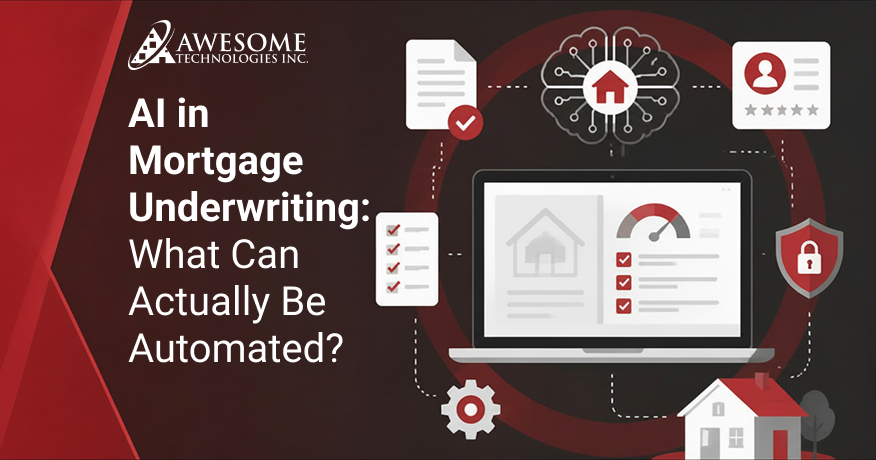
If a question about “AI underwriting” was asked from ten mortgage industry experts, there are chances of receiving ten various definitions from each of them. This is due to the fact some may say that a mortgage service can be automated completely, while others may argue it can be sped up only slightly. In fact, it looks like the answer lies somewhere in between, and it is high time to know it well.
In April 2026, Fannie Mae implemented Lender Letter LL-2026-04 stating that the rules of governance for AI and ML have become officially known for all companies offering automation services for the originations of loans. An important point to note is that this regulation will be in force from August 6, 2026. It can easily be deduced from one regulation that lots of things have been going on regarding AI underwriting as it became a process that is officially recognized and required from all lenders.
To know how AI works in mortgage underwriting, it is critical to remember that machines automatically perform repetitive, data-heavy, unemotional jobs. Meanwhile, human underwriters oversee intricate lending choices and ensure compliance with regulations. This guide will show how much AI can do when it comes to mortgage applications as well as when it is necessary for human underwriters to be involved, what technologies can be applied, and what has been gained in practice through the usage of AI.
What is AI in Mortgage Underwriting?
AI in mortgage underwriting comprises the implementation of machine learning algorithms, optical character recognition software, intelligent document processing, and predictive analysis techniques to read the documents submitted by a borrower. Also, it involves data validation provided by the borrower, credit risk assessment, detecting fraud detection schemes, and extracting any relevant information relevant to underwriting practice. On the other hand, the final decision regarding the risk of underwriting still depends on the rules of automated underwriting mechanisms as well as the company’s strategy, the instructions given by investors, and the manual checking process.
How AI is Changing Traditional Mortgage Underwriting?
AUS has existed for a long time in lending with regard to making loan qualification decisions for purposes of underwriting. With the advent of AI technology, this concept has been introduced into document processing, fraud detection, data extraction, and workflow management supply chains.
At present, 70 to 75 percent of the decisions made in lending are made automatically, without the intervention of underwriters, according to the opinion of lenders. Some of them plan to increase this percentage to 85 percent by 2026, which is an important milestone in underwriting. The main difference between AI and AUS is that AUS operates on a rule-based model stating the availability of loans while AI technology may be used in various other functions.
Why are Mortgage Lenders Investing in AI?
In today’s world, credit providers are seeking to be not only leaders in providing cheap prices but also those present on the market that can offer quick services while maintaining high risk. The majority of the representatives of the mortgage industry, according to the National Mortgage News survey, believe that AI underwriting technology may represent the biggest impact on the industry in 2026.
AI for mortgage lenders is important because it eases document review, offers underwriting support and assists in mortgage workflow automation. The use of AI in the mortgage lending process is crucial because it simplifies document processing, provides assistance with underwriting procedures, as well as improves mortgage operations. To learn more about mortgage automation in 2026 and how AI will help mortgage lenders make their operations faster and more compliant with the applicable rules and regulations, read through our detailed guide.
How the Traditional Mortgage Underwriting Process Works?
Key Steps in Manual Underwriting
Underwriting is one of the most critical stages of the mortgage approval process, where lenders evaluate borrower eligibility and risk. The traditional underwriting procedure consists of certain steps, such as collecting various documents, verifying income and assets, assessing creditworthiness and determining the property value. Financial risks also have to be approved by an underwriter who checks all the documents according to the investor’s or regulator’s requirements. Each of the steps depends on the other. Thus, if something is missing, the whole file can wait for days for the borrower or the third party to provide the appropriate document.
Common Challenges Faced by Underwriters
In terms of the conventional underwriting file, the process follows in sequencing that consists of paperwork requisition, checking the income and assets, evaluating credit rating, and assessing property value, and finally risk approval by the underwriter who must have a close look at each of the components to verify if they meet the requirements of investors and regulators. All of the above-mentioned stages depend on each other. This is to say that a missing paper could hold the entire file for days waiting for a borrower or a third person.
AI vs. Manual Mortgage Underwriting: Key Differences at a Glance
Before talking about the characteristics of AI loan underwriting, it is necessary to say that these techniques are always compared by the lenders since they need to know this information
| Factors | Traditional Underwriting | AI-Assisted Underwriting |
| Document review | Manual, by completing paper-by-paper by the underwriter | Automated Extraction and verification through OCR and IDP |
| Turnaround time | Depends on how difficult and the number of files in the queue | Hours for simple documents having 70%-75% of conditions verified automatically |
| Income verification | Paper forms and calls to employers | API calls made using direct integration with payroll providers like ADP and Workday |
| Consistency | Varies based on the skill level and workload of the underwriter | Same set of rules for all files means minimum variations in the result received by reviewer |
| Fraud detection | Depends on the reviewer’s capability to identify discrepancies manually. | Pattern recognition helps identify discrepancies in thousands of data |
| Handling complex files | Extremely high due to the ability to process cases involving various people and unusual cases. | AI is employed in underwriting, intricate cases being passed through AUS and manual process |
| Regulatory accountability | The human analysis serves as a natural auditing record | This must be combined with explainable AI and governance so as to comply with the Reg B and Fannie/Freddie regulations of 2026 |
| Cost per file | Due to the more manual aspect | It is extremely less in terms of regular records, notwithstanding the fact that its technological initial prices are higher |
Traditional lending processes are better than automated lending processes when it comes to complicated situations. On the one hand, automated lending processes win over traditional methods from the perspective of efficiency, cost, and consistency. Modern lenders successfully using technology in their processes do not favor either one method. This is because technology is used by lenders only in standard parts of the loan process.
What Can AI Automate in Mortgage Underwriting?
| Underwriting Task | Automation Level Today |
| Borrower Data Collection | Total automation through the usage of digital applications and APIs for document retrieval. |
| Income and Employment Verification | Partial automation via automation using payroll and bank APIs. |
| Document Classification and OCR | Complete automation since millions of documents are being processed every month. |
| AI Mortgage Credit Risk Assessment | Automatic scoring of loans but verifying the hard cases manually. |
| Fraud Detection | Automation of the document pattern recognition with the manual verification of suspicious loans. |
| Property and Collateral Analysis | Partial automation due to possibility of manual actions during the verification. |
| Compliance Checks | Automation with manual control in case of doubts. |
| Loan Decision Recommendations | AI recommendations with human authentication for complex cases |
-
Borrower Data Collection
Nowadays automated application procedures automatically extract all necessary information related to the borrower from their bank accounts, from their employer’s database, and from credit agencies as well. This allows the borrowers to skip the process of entering a lot of information related to them manually. As a result, one of the most significant causes of the delays in the data entry process is eliminated before underwriting starts.
- Income and Employment Verification
In order to get income verification from the borrower’s employer in a few hours instead of waiting for several days, the lender obtains the essential data from the payroll service providers (such as ADP, Paychex, Gusto, and Workday) through Findings.
-
Document Classification and OCR
The OCR system categorizes each document in the following types: those related to a confirmation of income, taxes, banking, etc. Tinman developed by Better Mortgage and Rocket Logic from Rocket Mortgage use OCR technology along with others provided by Ocrolus and Candor. This allows it to process millions of data points every month without any human involvement.
-
Credit Risk Assessment
Analyzing data and exposing patterns and risks using AI makes credit risk assessment possible. The process is based on information produced by an AI that cooperates with AUS and considers criteria of the respective lenders. Moreover, AI supports borrower risk assessment by analyzing credit, income, and financial patterns.
-
Fraud Detection and Identity Verification
AI fraud detection in mortgage lending uses machine learning to identify document inconsistencies, suspicious activity, and identity fraud faster than manual reviews. Machine Learning in mortgage lending helps in checking documents for inaccuracies, suspicious activities, etc. faster than a person would do.
-
Property and Collateral Analysis
The implementation of AI technology is able to facilitate appraisal checking and the detection of mistakes and defining comparable sales. Despite that, humans will make the final decisions in appraisals and underwriting.
-
Compliance Checks
Automated systems allow the comparison of models to the guidelines of the investor, fair lending laws, and disclosure laws. This gives an opportunity to avoid any loopholes in busy operating weeks.
-
Loan Decision Recommendations
AI technology can offer recommendations on certain actions, like finding missing papers, searching for danger signs, and sending the file for manual checking. However, the final underwriting recommendation will be based on the output of AUS and the underwriter’s decision.
What Still Requires Human Underwriters?
A common question is can AI replace mortgage underwriters? The answer is no because:
-
Complex Borrower Profiles
Self-employed borrowers or those with multiple sources of income require human underwriters who can evaluate some parts that can’t be interpreted by computers.
-
Exception Handling
Automation can achieve machine learning but can still experience exceptional cases requiring human intervention.
-
Final Lending Decisions
AI can’t be taken for granted. While it can perform many tasks, final decisions depend on the lender while considering policy, guidelines, and human intervention.
-
Regulatory Oversight
Any law requires some justification for the credit decision. If an AI model is unclear, there is a high risk of violations.
Benefits of AI in Mortgage Underwriting
- Faster Loan Processing is made possible when normal conditions automatically pass through rather than waiting in an underwriter’s backlog along with dozens of other files.
- Accuracy is guaranteed by a continuous, rule-based system that never gets tired or gets distracted like a human checking on his fiftieth file of the day.
- Reduced Costs come about due to lower labor hours spent verifying and checking the documents.
- Improved Borrower Experience is made possible because there will be quicker decisions and less requests for documents that the borrower already provided.
- Risk Management gets improved through pattern recognition systems catching inconsistencies that a manual system might not have caught.
- Many AI platforms also provide interactive dashboards that allow lenders to monitor underwriting performance, loan pipelines, borrower risk, and operational KPIs in real time.
Challenges of AI in Mortgage Underwriting
- Privacy and Data Security
AI applications have access to immense amounts of private and confidential information about borrowers, their incomes, Social Security numbers, banking information. So it is necessary for lenders to invest in robust encryption and access control systems rather than focusing only on the strength of models.
- Bias in AI and Compliance With Regulations on Fair Lending
A model that is developed based on the historical lending data might end up learning and replicating past biases unless the lenders check and correct this problem of bias explicitly.
- System Integration
Lenders continue to operate on core systems that were developed long before AI-based solutions were even available, and therefore integrating new technology with the existing system might require a lot more effort than developing the model itself.
- Regulations
Current regulations that provide consumers with protections, including the Truth in Lending Act and the Equal Credit Opportunity Act, continue to apply to AI-based decisions without providing an exemption for automated systems.
AI Technologies Powering Modern Mortgage Underwriting
-
Machine Learning
ML models that are trained on historical data about the past performance of loans will improve with each additional file processed because these models use machine learning techniques to score risk and predict outcomes.
-
Optical Character Recognition (OCR)
OCR in mortgage underwriting takes your scanned or photographed document and turns it into structured and searchable data. This forms the cornerstone for all of the rest of the automation pipeline!
-
Natural Language Processing (NLP)
Natural Language Processing (NLP) enables systems to understand unstructured data such as notes in a loan file or free-form borrower explanations that cannot be interpreted by a purely numeric system.
-
Predictive Analytics
Predictive Models Predictively model what kinds of loans (or loan apps) will be more likely to default (or close).
-
Intelligent Document Processing (IDP)
The IDP takes that concept further by combining OCR, machine learning and NLP into one pipeline. So instead of just reading a document, IDP can understand its contents within the context of other data to flag inconsistencies.
Real-World Examples of Artificial Intelligence in Mortgage Underwriting
-
AI Income Verification
By utilizing AI for income verification, lenders can ensure that they are verifying their borrowers’ incomes accurately. In other words, lenders will no longer have to rely entirely on manually reviewing documents when they can analyze and verify this data using AI.
-
AI-Powered Fraud Detection
The emergence of generative AI has made it increasingly challenging for investigators to spot fraudulent activity when dealing with forged documents such as fake pay stubs and bank statements by hand. That’s where AI document verification comes in, making checks on data against source systems rather than looking at document appearance an absolute necessity.
-
AI Document Processing for mortgage
Both Rocket Mortgage’s Rocket Logic engine and Better Mortgage’s Tinman platform help them handle the large volume of loan documents they receive on a monthly basis. They also automatically extract and validate data so their employees are free to concentrate solely on reviewing documents where human judgment truly counts.
How to Choose an AI Underwriting Solution for Your Lending Team?
When evaluating the best AI mortgage underwriting software, lenders should consider integration, explainability, security, and compliance. The decision of which mortgage AI solution best fits your lending team is no less important than whether you want to take this step toward automation at all. In fact, rushing into choosing the wrong solution often creates far more work than it solves, so consider these key questions:
- Does it integrate with your existing LOS? It’s no good if it doesn’t seamlessly integrate with Encompass/MeridianLink/whichever system you currently use. If there are multiple workflows when using another tool then integration is incomplete at best. Innovative lenders operate in a way where they don’t favor one method. They use technology only for a few fixed portions of the loan process. Know more about it in our article on mortgage automation vs. manual loan processing for a detailed comparison.
- Can it explain its decisions? So with all the 2026 Fannie Mae & Freddie Mac governance rules about to hit, you’d want as much transparency into the process as possible. Any solution that doesn’t provide this kind of human-readable rationale isn’t going to be viable.
- What’s the real accuracy rate on your loan mix? These days, most vendors will highlight some sort of accuracy figure to demonstrate their product’s effectiveness. It might be an overall number, but sometimes these can represent a very specific subset of borrowers (i.e., it may be great for self-employed borrowers, but terrible for non-QM).
- How does it handle data security? These touch sensitive items such as Social Security numbers, income data, and your bank’s record keeping. Confirm their encryption standards and access controls before you sign anything.
- What does implementation actually cost and take? You have to account for more than just the licensing price when considering an implementation of mortgage underwriting software because that’s usually where most companies’ budget goes over. Factor in the amount of time needed for staff training and integrating into existing systems.
Regulatory Landscape: The 2026 AI Governance Rules Lenders Must Follow
Lenders will now have limited room when it comes to combining AI into their mortgage underwriting operations. In fact, many of these regulations are already in force. For example, Freddie Mac’s Bulletin 2025-16 went live on March 3, 2026. This requires sellers and servicers to implement continuous risk based governance related to AI throughout the entire lifecycle of a loan including but not limited to underwriting automation, document intelligence, mortgage fraud detection, and other areas such as borrower facing chatbots.
Fannie Mae’s more recent Lender Letter LL-2026-04 also confirms that sellers document specific policies related to AI development, deployment, and ongoing risk management. Compliance with this letter was due by August 6, 2026. Additionally, the OCC, Federal Reserve, and FDIC recently published revised model risk management guidance addressing AI and machine learning models. It is different from the previous guidance focused alone on AI which was built upon existing guidelines from SR 11-7.
| Regulations | Effective Date | What It Requires? |
| Freddie Mac Bulletin 2025-16 | March 3, 2026 | Continuous AI governance across the full loan lifecycle |
| Fannie Mae Lender Letter LL-2026-04 | August 6, 2026 | Documented AI/ML governance policies for sellers and servicers |
| Interagency Model Risk Guidance (OCC Bulletin 2026-13) | 2026 | AI-specific model risk standards replacing SR 11-7 |
The bottom line is the ability of the model to explain what caused it to flag or deny a certain file. It certainly goes beyond a trust issue. Name it as now a Regulation B compliance violation. In other words, if your model can’t tell you why it did what it did, it will dissatisfy regulators and put your lender at possible risk. Explainability has become an increasingly important compliance factor when lenders use AI technologies especially when it comes to making sure fair lending practices, unfavourable action requirements and model risk governance.
Best Practices for Implementing AI in Mortgage Underwriting
-
Define Automation Goals
First it is important to figure out what are those exact points that have been identified as bottlenecks. Maybe you’re having slower-than-expected time for income verification or more manual reviews. It’s important to identify workflow bottlenecks before investing in automated mortgage underwriting, rather than buying the technology first and only then trying to determine how to use it.
-
Ensure High-Quality Data
AI models are only as good as the data they’re fed. If your historical data about loans isn’t clean or consistent, chances are you’ll end up with an AI model that’s repeating these issues on a larger scale.
-
Maintain Human Oversight
Ensure that a qualified underwriter stays in the loop for every important decision relevant to mortgage underwriting automation because regulators increasingly demand human involvement in AI systems.
-
Monitor AI Performance
Keep an eye on your track’s performance and monitor for accuracy, bias indicators and exceptions throughout the life of your deployed model. This will ensure you don’t lose grip and start slipping out of your initial lead. A model that did well when deployed may start drifting once market conditions and borrower profiles change over time.
The Future of AI in Mortgage Underwriting
Automation in mortgage underwriting shall advance from the basic AI systems to the more complex agent-style AI that will not only signal an issue but act on it as well. Instead of informing a mortgage underwriter of the missing document or the need to verify income information, this technology will perform simple tasks on its own which will reduce the number of delays and the amount of manual work. Lenders also will be relying more on non-standard credit history data as well as alternative data sources, like rent payments.
At the same time, legislation on AI technology will constantly increase the requirements and expectations. Companies using AI technology early will be ahead of those having to change outdated systems due to the legislation requiring them to do so.
In Conclusion
The time of regarding AI as a technology for future use in mortgage underwriting is over. In 2021, the regulations from Fannie Mae and Freddie Mac came into effect, which means adopting AI technology is no longer just a strategy. From this moment, it is also a requirement especially in 2026 and onwards.
By automating routine tasks up to 85 percent of the time when working with various data, the underwriting team will access new paperless processes and save time. Experienced underwriters will be able to dedicate their time to complex and high-value cases. Those organizations that use automation and human skills effectively will attract a larger number of customers in the future.
Looking to modernize your underwriting process? Our custom mortgage software development services help lenders build secure, compliant, and AI-powered solutions tailored to their workflows. Contact us today to discuss how we can develop a custom mortgage platform that streamlines underwriting, automates repetitive tasks, and supports long-term business growth.
Frequently Asked Questions
1. What is AI in mortgage underwriting?
AI in mortgage underwriting utilizes technology such as machine learning, optical character recognition, and predictive analytics to read documents, confirm borrower information, manage credit risk, and make loan decisions efficiently.
2. Can AI replace mortgage underwriters?
No. While digital mortgage/AI can facilitate the repetitive and straightforward parts of underwriting, it still needs a licensed underwriter for special cases and important lending decisions.
3. What mortgage underwriting tasks can AI automate?
AI can help automate the collection of information, categorization of documents, the processes of verifying income and checking for fraud, as well as routine mortgage compliance processes.
4. Is AI underwriting more accurate than manual underwriting?
AI improves consistency by applying the same rules to every file without fatigue, but accuracy depends heavily on data quality, and human oversight remains essential for catching edge cases models miss.
5. How does AI reduce mortgage fraud?
AI-powered verification platforms help validate income and identity against trusted payroll and financial data sources, reducing reliance on uploaded documents alone while helping detect inconsistencies and potential fraud.
6. What are the biggest challenges of AI in mortgage lending?
Data privacy, algorithmic bias, integration with legacy systems, and keeping pace with new 2026 regulatory requirements from Fannie Mae, Freddie Mac, and federal banking regulators rank among the top challenges.
7. Which mortgage lenders use AI?
Rocket Mortgage, Better Mortgage, and numerous banks and independent lenders now run proprietary or vendor-based AI tools for document processing, income verification, and fraud detection across their underwriting operations.
8. How can lenders implement AI in underwriting?
Lenders should define clear automation goals, ensure high-quality training data, maintain documented human oversight, and continuously monitor model performance to stay compliant with evolving AI governance requirements.