
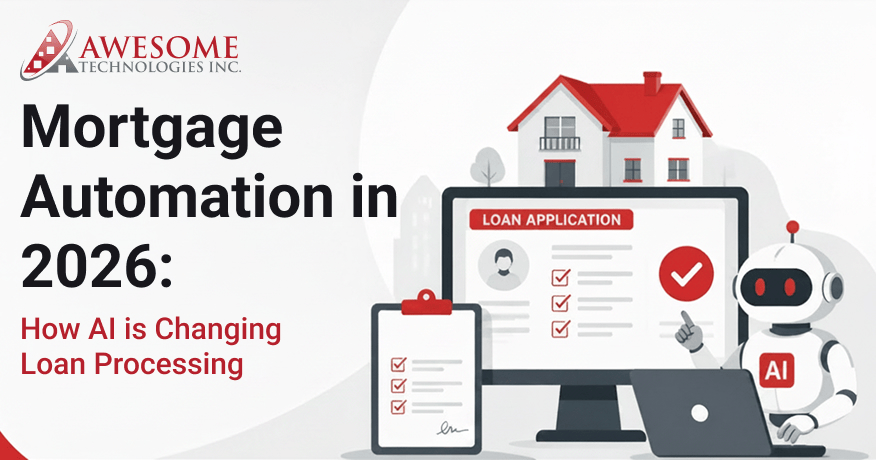
Imagine a borrower submitting a mortgage application on a Tuesday morning, and by Tuesday afternoon they have a verified income analysis, a risk-scored file, and a conditional approval sitting in their inbox! No more endless phone tags, multiple paper forms or waiting for 3 weeks. It is a reality for lenders that are using AI mortgage automation in 2026. However, for those still using outdated business methods, the gap is widening at an alarming rate.
This guide outlines today’s mortgage automation in detail and how AI is changing the entire landscape. We did independent research from the leading platforms and analysts currently working in this sector. So, every detail here is accurate for the mortgage industry as it exists in 2026!
What is Mortgage Automation?
Mortgage Automation is the use of advanced technologies and integrated software systems to simplify and track the complete mortgage process from application/document collection through underwriting, compliance, and closure. By streamlining efficiencies, lowering operating costs, providing greater accuracy, shortening loan processing times, and improving the borrower experience, enterprise lenders can maximize their operational investment with mortgage automation.
While there have been technological advancements in the mortgage automation category over the past two years, the same is not true for lenders using these technologies. According to Areal.ai, lenders in 2026 will see the same dramatic shift from their previous mortgage automation practices. While mortgage automation consisted of OCR scanners or bots copying data from one field to another in the past, mortgage automation today now depends on:
- Intelligent classification of documents
- Extraction of thousands of data points
- Validation against investor and compliance regulations
- Running entire workflows automatically with limited human review
Now, let’s look at three different generations of mortgage automation:
- Generation 1 — RPA and Basic OCR (2015–2020):
In the early days of RPA technology, the only application for it was rule-based bots to fill out forms and input data from predictable, structured documents. While AI loan processing provided speed in handling simple cases, it was of no use when processing unstructured documents that were either “messy,” handwritten, or not-standard in nature. The accuracy of OCR engines for real-world processing of mortgage documents was around 50% to 60% for most engines.
- Generation 2 — Specialized Document AI (2020–2024):
Beginning with training machine learning models using millions of mortgage documents, companies were able to classify the various document types as well as the layout variations for each document. It allowed them to create structured data that is valid and guaranteed to be accepted in a production-type environment. With this capability of mortgage automation 2026, it was feasible for companies to validate a person’s income, assets, closing disclosures, and post-closing packages without having a human read every document.
- Generation 3 — Agentic AI (2025–2026):
Agentic systems are capable of reasoning, taking action and completing multiple workflows in addition to simply gathering data. An Agentic AI can read a closing disclosure, compare each line against expected lender fees, find discrepancies, email exceptions to title company, update LOS after all corrections confirmed, and notify closing agents of readiness to fund without human intervention. Even as agentic AI becomes more advanced, most production environments still run on platforms like Encompass, BytePro, and MeridianLink. Here, the automation layers are gradually added on top of established LOS infrastructure.
How AI is Transforming Loan Processing?
Loans are being processed much faster and smarter due to the help of Artificial Intelligence (AI). In the past, loan approval required many hours of manual checks, high levels of paperwork, and long wait times before approvals were complete. However, through the use of AI mortgage technology, lenders can now automate many of the tasks linked with the loan process such as verification of documents, assessing a credit report, detecting fraud, and validating income.
In minutes rather than days, lenders can review all of the data provided by the borrower to determine risks and have improved decision-making. Borrowers can also receive instant updates and assistance throughout the entire application process via AI chatbots. All of these improvements allow banks and lenders to process more volumes of loans faster. The borrowers also have an overall better lending experience by being able to receive their approval much quicker, with effective communication and a smooth process.
The Numbers Driving Urgency
According to “Research Nester” in 2024, the AI Lending Market will be worth $109.73 billion as of 2024, and by 2037, it is expected to grow to $2.01 trillion at a CAGR (Compound Annual Growth Rate) of 25.1%. This ensures that development of the underlying infrastructure for AI Lending is much more critical than simply developing a technology. For the next three years, most lending decisions from mid-to-large-sized lenders will use the AI model as their primary tool to make decisions.
“AI-driven decision-making is now transitioning from an elective functionality towards becoming an essential functionality. Any bank that does not implement production-ready models prior to 2026 will incur a cost disadvantage of 15% – 20% in consumer lending compared to their AI-native competitors.”
— Celent, Banking Technology Outlook 2026 (as cited by TIMVERO)
Here are also valid performance figures that will support why there are such rapid rates of adoption:
| Metric | Traditional (Manual) | Mortgage Automation 2026 |
| Average loan processing time | 18 – 45 days | 3–5 days (the best case not an average one) |
| Cost per loan originated | ~$9,000 (MBA, Q4 2025) | ~$5,200–$6,500 with automation |
| Underwriter time per file | 3–4 hours | 45–60 minutes (exceptions only) |
| Document extraction accuracy | 50–60% (OCR) | 97–99% (Document AI) |
| Data points analyzed per borrower | 50–100 | 10,000+ (McKinsey, 2024) |
| CD balancing time per session | 45–65 minutes (depends) | 2–4 minutes |
| Post closing review time | 90+ minutes per loan | ~20 minutes |
| Increase in processing speed | Baseline | 90% faster (Business Research Company, 2024) |
The cost pressures in the mortgage industry are a significant concern due to the high cost of technology. There are many ways that high-volume lenders can use AI technology to reduce their costs by an average of 42%. For example, when an origination company originates 24,000 loans each year, they will incur manufacturing costs of approximately $216 million. If this company utilizes AI mortgage automation to reduce their costs, this reduction could contribute significantly to a positive effect on their bottom line.
The Three Forces That Changed Everything Between 2024 and 2026
There were three structural shifts that contributed to the adoption of AI in the mortgage industry between 2024 and 2026. Therefore, it is important to understand these shifts in detail to understand why the speed at which the adoption occurred was so rapid:
First: Agentic AI frameworks matured enough for regulated production environments
The agency AI has matured enough to become useful for loans within a regulated production environment. In 2024, there was an AI assistant to help the loan officer in lending to the customer but in 2026 there are now autonomous AI agents who are able to control a multi-step underwriting process. These agents are able to pull the required data, run risk models, identify risks and route the exceptions out to the right human resource for review.
Second: Regulatory enforcement arrived
Institutions will be required to formalize the AI systems, biased auditor, and human oversight requirements into legal contracts. Furthermore, the addition of domestic documentation requirements reflected in Fannie Mae’s Lender Letter LL-2026-04 on the governance of AI will likely result in more burdens on lenders.
Third: Compressed margins made efficiency a survival issue
The impact of rising interest rates and compressed margins on lenders is most critical between 2024 and 2025. With mortgage automation for lenders, some of them will have reduced their per-loan processing costs by 30% to 40%. Thus, the gap between lenders who have achieved operational efficiency through automation and those lenders who continue to maintain manual workflows on a large scale will no longer be a point of comparison between lenders.
Where Automation Actually Lives in the Loan Lifecycle?
Here is a step-by-step breakdown of where automation is genuinely delivering results in 2026:.
Application and Borrower Onboarding
When the borrower uploads their documents to the automation platform (W-2s, pay stub, bank statement and/or tax returns), the automation platform will classify each page in seconds and then extract and verify the data. As soon as the processor has all pages uploaded and indexed, they have a complete visualization of what was submitted.
Areal.ai can now provide 24/7 multilingual assistance through the nCino Mortgage Advisor (available through the nCino Mobile App) to the borrower from application to closing. With the support of Areal’s Copilot Processor Agent, lenders can save between one and three hours on each loan for both the onboarding and setup processes.
Income Verification and Analysis
Today’s AI technology ingests the previous documents and outputs a verified total income calculation that is fully aligned with GSE guidelines in mere minutes. What would traditionally take an underwriter 2-3 hours for each complex file, the AI completes within just a few short minutes.
Steve Butler, CEO of TRUE, explained why only partially automating the income verification process does not provide any value to lenders: “When you have to manage the results of a tool by hand, is it really benefiting you? That’s the fundamental problem with Assistant-based AI; the tools still require a human being to clean up their output.’’ However, when AI can independently manage the manufacturing process in the mortgage industry, that is when lenders realize a true return on their investment.
A mortgage professional working for one of the highest-volume lenders has shown this change in the following words: “I’ve tested systems that have the ability to evaluate an entire loan file, provide conditions and points of risk, and do it in a manner that is almost identical to an underwriter. For example, one of these systems identified a discrepancy between a borrower’s stated occupancy and their home insurance coverage. That isn’t a simple check box task, but rather an example of analytical reasoning.” (Mortgage Professional, April 2026)
Automated Underwriting System (AUS) Navigation
The introduction of nCino’s AUS Smart Tasks feature is altering the manner in which loan officers are able to access and review Fannie Mae DU & Freddie Mac LP results. Rather than being provided with the raw output generated from an automated underwriting system, the AUS is producing summary information in plain language and providing recommendations related to the next steps to take. This not only reduces the amount of cognitive effort for a loan officer to process, but also reduces the number of unnecessary touches on each file.
Through the use of AI for mortgage origination with self-employed Borrower profiles, it can identify the correct documentation types. Reducing this type of context-dependent delay allows an underwriter to begin work on an application almost immediately upon receipt without additional delays.
Closing Disclosure Balancing and Fee Reconciliation
This is the point at which the calculations for ROI become most real. It takes an average of 45–65 minutes each session (totally dependable) to compare the lender’s closing disclosure (CD) to the title CD on 50–60 line items. See where there are any discrepancies in the amount charged vs. amount paid on items, and then recalculate those amounts manually. Typically, lenders need to complete this task over 3–4 times per loan.
With Areal’s purpose-built CD Balancer, 95% of these comparisons are done automatically, and closers only have to review the remaining exceptions to see if there are any issues. This results in notable savings.
Post-Closing Quality Control
The post-closing review falls at the ugly end of the loan lifecycle. Hundreds of pages are reviewed against investor guidelines. Therefore, approximately one in 10 loans is returned. Each returned loan costs time to remediate, negatively impacts the lender/investor relationship, and creates the risk of potential repurchase.
Automation refers to automating the auto-verification of investor checklists, as well as detecting missing pages, stamps, and signatures. In addition, they are compiling investor packages in compliance with the investor’s requirements for loan documentation. There is 40 to 80 minutes saved on each loan being reviewed.
AI Beyond Documents: Credit Scoring Gets a Rebuild
Although the most evident aspect of AI mortgage technology is document automation, the more significant change happening in the lending process is with credit assessment.
FICO developed their credit scoring system in the 1980s, a time when there were very limited sources of data collected on consumers. Their scoring system evaluates borrowers on five factors: payment history, amount owed, length of credit history, new credit, and mix of credit; all evaluated using historical data collected from the 1990s. Therefore, the way FICO scores borrowers has resulted in 45 million Americans being considered “credit invisible” or “thin files”. This criterion leaves out many consumers who could otherwise be considered credit-worthy.
There are five layers of work involved in the overall architecture for how AI loan processing works:
1) Intelligent Document Processing extracts data with an error rate of less than 1% in production for structured documents;
2) Real-time data enrichment by querying credit bureaus and bank verification APIs at the same time with a response time of less than 10 seconds;
3) Machine Learning for risk scoring through the use of ensemble models;
4) Decision engine that combines the ML scoring with the lender’s credit policy;
5) Workflow routing that sends clean approval cases to be sent to disbursement and sends exception cases to Loan Officers with a pre-packaged case file.
The Execution Gap: Why 97% Plan It But Only 14% Have Scaled It?
Currently, there is a lot of frustration in the mortgage technology market with this statistic highlighting that 97% of lenders say they plan to implement intelligent automation but only 14% of lenders have scaled intelligent automation. This gap has been documented in a white paper produced by nCino on intelligent automation in mortgage lending.
What causes these gaps? nCino outlines a few of the root causes:
- The integration problem. Many automation solutions now available for mortgage processing do not have the ability to effectively work with older technology. It is also important to note that lenders who have leveraged mortgage automation 2026 within their organizations now primarily have successfully automated using cloud-based technology platforms such as Encompass or similar solutions. These lenders also have leveraged technology with a focus on modern SaaS architectures vs. relying entirely on older systems.
- The accuracy anxiety. 94% of lenders report being anxious about likely inaccuracies in AI-based underwriting and compliance. The consensus from nCino and throughout the entire industry is that human-in-the-loop will help resolve all AI-related concerns. Whenever a loan officer reviews an AI output for accuracy or corrects an AI output for some reason, this serves to train the AI model.
- The change management gap. There is a management gap when it comes to implementing technologies, which often leads to poor outcomes. Those lenders that have successfully put automation into their business, seeing a return on investment (ROI) of up to 10x, did so by redesigning their processes around what is possible using artificial intelligence (AI). On the other hand, the lenders who simply added automation tools to their existing human-based processes have not done nearly as well.
The most important piece of advice nCino provides with respect to closing the management gap is that you should validate before scaling your efforts. Your best bet related to AI mortgage automation is to start with one process, measure that against a baseline, and then grow from there. Many lenders attempt to automate everything at once and tend to stall out as a result. Lenders that start with the most challenging processes, such as loan closing or post-closing quality control (QC), are likely to achieve positive ROI quickly and will generate momentum within their business.
Real Quotes From the Field
Data represents generally how working people who run these systems day to day experience them.
- On time savings per loan:
A mortgage professional using Zeitro for the verification process: “Manual underwriter’s process has existed as conversation between people for many years. Therefore the amount of time saved by using AI tools will be in excess of seven hours that I could use for having a conversation with my underwriter discussing reasons for the borrower’s situation.”
- On the quality shift:
A CEO at a Direct Mortgage Corporation using Multimodal’s AI Underwriting Agents stated: “It’s incredible that we can reduce processing time from three-and-a-half hours to forty-five minutes while increasing quality.”
- On what actually drives implementation success:
According to Casey Williams, the General Manager at nCino Mortgage: “Innovation in mortgage lending is greater than just the digitization of processes. It represents a transformation of how both the lender and borrowers experience the mortgage lending process. By uniting the benefits of intelligent automation and human expertise, nCino provides lenders with a competitive advantage”
- On the risk of partial automation:
Leah Price, General Manager of Better.com’s Tinman AI Platform: ‘’The mortgage sector is full of inefficiencies that negatively affect not just consumers; they also affect the loan officers and lenders who serve those consumers. Large mortgage aggregators in the broker and correspondent channels typically charge a sort of 1%-2% tax on each loan just for underwriting a mortgage and delivering it to an institutional investor. Well, that’s about to change.’’
The Platforms Actually Moving the Market
Several platforms are taking different paths toward AI mortgage automation, as of 2026. Knowing which platforms provide what sort of value will allow lenders to determine where their best entry is.
- Areal.AI provides the complete closing and post-closing stack including document classification; CD balancing; funding review; post-closing QC; and agentic workflow execution. Specifically trained on mortgage documents because they process millions of pages per week allows Areal.AI to offer a Copilot Agent with out-of-the-box agents for borrower onboarding, funding review, post-closing review, insurance verification, appraisal review and title review. The total platform ROI is estimated between $240 and $480 per loan or 6-10 times as much for lenders utilizing both products.
- The nCino platform is an enterprise operating system that unites Artificial Intelligence agents, bankers, and over 14 years of banking industry experience on a single, purpose-built platform. The five Digital Partner Roles (Executive, Analyst, Service, Processor, and Client Agents) are specifically designed for specific banking roles in a way that is much more effective than dealing with generic workflow processes. Their mortgage advisor, AUS Smart Tasks, and doc verification features are all currently available and in production at over 2,700 financial institutions.
- TIMVERO approach to developing the lending OS platform is by using composable infrastructure. Its approach to alternative credit scoring (10,000 vs. 100), agentic underwriting, and ROI benchmarks for alternative credit models based on real-world implementation is among the most analytical perspectives on how AI could affect the broader lending ecosystem, particularly outside of mortgages.
- ICE Mortgage Technology: Encompass still leads with 400+ integrations to partners prebuilt into the LOS. Their AI mortgage automation policy clearly states that AI will never make decisions around approvals, pricing, and disclosures, while cash movement and investor remittances would still require human oversight. Businesses looking to maximize platform efficiency often rely on Encompass automation services to handle a great amount of work.
- Better.com Tinman AI has the most radical application among those that have actually gone live. It was implemented through the connection between ChatGPT Enterprise and MCP in such a way that the underwriting process happens in a few seconds.
Across all these approaches, Encompass, BytePro, and MeridianLink remain foundational systems where most lenders deploy automation first before layering advanced AI capabilities on top.
The Compliance Reality: What Regulation Actually Requires?
One cannot deny the benefits of AI mortgage automation. AI creates automatic audit trails containing timestamps for every data point input, every comparison made, and every exception raised in the process. Where a CFPB examiner asks “why was this loan granted approval?” the AI-enhanced workflow will have a structured answer, while the manual workflow won’t.
Things to consider widely:
- AI systems will not make final decisions on loan approval, pricing, or disclosure issues
- All cash movement decisions will be explicitly authorized by humans
- Bias audits and explainability will not be optional features but mandatory governance processes
- Human-in-the-loop machine learning creates an audit trail over time
Will AI Replace Mortgage Professionals?
What we’ve seen automated has been the operational repetitive portion: reading documents, copying data from system to system, using checklists on every file, following up on conditions via email. That work is disappearing from human workers rapidly.
What is left and is becoming increasingly valuable is expertise, managing relationships, and understanding complex problems. The loan officers who provide value by advising, being contextually aware, and developing relationships will find themselves in a stronger position in 2026. The loan officers who purely add value with transactions (paper moving, field filing, checklist management) will have a real risk going forward.
Who is Seeing the Highest ROI Right Now?
Based on deployment data through early 2026, the highest return on AI for mortgage automation investment goes to:
- Regional and community banks originate 300 to 2,000 loans a month, have the most manual processes, and stand to benefit greatly from Innovation.
- WisdomStream documented a Miami loan shop with a five-processor staff, each recovering two to three hours of processing time each day at a cost of $3,500 to implement.
- Non-depository mortgage lenders compete on speed of processing applications. AI enables them to compete with traditional financial institutions.
- Portfolio lenders using a variety of options under the non-QM title, can analyze complex loans and resolve quickly with more accuracy.
- Credit unions can speed up their decision-making process and provide clearer communication regarding loan status to their members.
The 9 Questions to Ask Before You Sign Anything
- What Mortgage Document Types does the application support out-of-the-box (OOB)?
- What accuracy does the application have on critical data fields, and how is that accuracy measured?
- What Loan Origination Systems does the application natively integrate with?
- How does the application handle exceptions and edge cases?
- What does your agentic AI layer do and can you provide live examples using my documents as examples?
- What does the application do to create audit trails for regulatory review purposes?
- How long is the implementation timeline and what is the complexity of the integrations with my current LOS?
- What are the different pricing models for the application per Loan, per User, and per Feature?
- What will Customer Support be like for my account once we go live and who in your organization will be responsible for managing that relationship?
The Bottom Line
The year 2026 will see the implementation of AI mortgage automation on a broad scale. For all competitive lenders, this is an accepted operating standard. There is now a significant enough difference in performance between AI loan processing and manual processes to quantify that difference in terms of dollars, days and borrower satisfaction scores.
Currently, the lenders who are winning are not those lenders with the largest AI budgets. They are the lenders who recognize which step in their individual loan manufacturing process in terms of quality control, income verification, and automated underwriting system.
The human mortgage professional will remain important in the lending process. However, their role is evolving from that of information gatherer to that of providing judgement, relationship and expertise. The only thing required is to become comfortable allowing the artificial intelligence to do what should never have required a human to perform.
As lenders strive to remain competitive, they require a technical partner who understands both the mortgage process, as well as the scope of intelligent automation. Awesome Technologies Inc. provides automated mortgage solutions using AI to allow lenders to update their workflow processes with improved accuracy and efficiency.
Are you interested in transforming the way you lend? Contact us now for information about ways that your organization may utilize intelligent automation as a means of providing you with future proofing of your business for 2026 and beyond!
Frequently Asked Questions
1. Is AI mortgage processing secure and compliant with CFPB standards?
All algorithms will integrate the requirement for compliance with publishing rules & standards as mandated by the CFPB into their OP System design, and will be approved by a recognized audit company like SOC2 Type II.
2. Can AI approve a mortgage without a human reviewing it?
Loan files can only be prepared by an AI, validated by an AI, exceptions flagged by an AI. However the final approval will be done by an Underwriter.
3. How long does AI mortgage processing actually take?
When using an AI-enabled loan processor to approve standard loans, the conditional approval should be done within 60 minutes. The lenders complete the overall loan closings in 3 to 5 days for conventional loan purchases. Most processing times are determined and monitored using historical data. Therefore, the average time for a loan to close manually will be approximately 18 days.
4. Why have only 14% of lenders scaled automation despite 97% planning to?
A significant reason for the low automation adoption rate is the execution gap, which can be attributed to a number of issues:
- The level of difficulty associated with integrating with legacy technology platforms (LOS),
- The limitations of AI technology when making compliance-based decisions,
- Change management – many lenders are adding automation to existing processes that were developed for humans to undertake.
5. Which lenders benefit most from mortgage automation?
Regional banks, non-bank mortgage companies, portfolio lenders with complex loan products, credit unions that have a high volume of manual loans (300-2000 per month).