
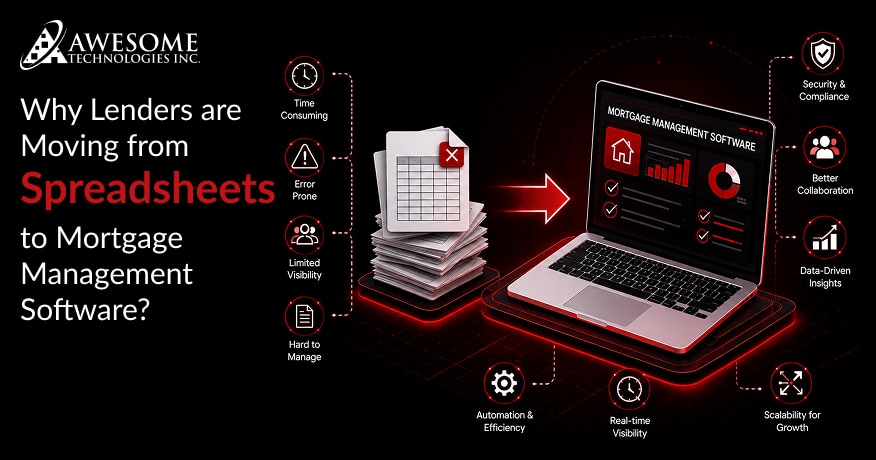
Consider getting out of bed on Monday morning to realize a single broken cell formula in your Excel sheet caused your entire portfolio’s interest calculations to be off for three months straight. Microsoft Excel and Google Sheets have been the go-to multi-purpose toolkit for loan officers for generations.
Using complex workbooks, nested VLOOKUP functions, and manually entering data, lenders built multi-million dollar loan pipelines. But things are changing rapidly for the mortgage industry due to stricter regulatory compliance, changing consumer expectations, and ever-growing concerns about data security. As a result, more and more lenders are leaving behind spreadsheets in favor of automated software solutions for managing their mortgage operations.
This guide describes how mortgage teams across the country can use data to make smarter decisions while leaving behind spreadsheets and adopting reliable loan management software.
Risks Of Spreadsheets
There are many independent lending companies, private funds, and community banks that use spreadsheets to manage loan originations. You likely already own the office productivity software and your staff likely already know how to enter rows, and it only takes about twenty minutes to build a basic amortization table. The danger comes when your portfolio exceeds twenty active loans which can pull your employees into the swamp of untracked updates and manual calculations.
Wondering about what are the risks of using Excel for spreadsheets? Let’s shed light on each of them.
1. The Human Error Factor (The 88% Problem)
Research has found that approximately 88% of business spreadsheets contain at least one error, although the severity of those errors varies. In mortgage lending, even a small formula mistake can affect loan calculations, reporting, or compliance. However, in the mortgage lending ecosystem, breaking one cell could cause you to miscalculate a borrower’s DTI ratio and under-report a LTV ratio or produce an inaccurate Loan Estimate.
After loan processors use manual spreadsheets without validation checks, it is possible for them to make errors. For example, a loan processor could enter an extra zero in a loan amount field or accidentally remove the dollar sign from the cell of an interest rate. Once there is an error in the manual spreadsheet, one cannot discover it as soon as possible.
2. Version Control Nightmares and the “Single Source of Truth” Deficit
When any part of the mortgage pipeline is being tracked by more than one person, the mortgage pipeline tracking typically falls apart. Several parties such as loan officers, underwriters and closing coordinators will all need access to a borrower’s file at the same time.
- Processor A saves Pipeline_2026_Final.xlsx on a local hard drive.
- Underwriter B opens an older version from an email attachment and saves it as Pipeline_2026_Final_v2_EDITS.xlsx.
- The closing coordinator updates a third copy named Pipeline_2026_UPDATED_COMPLETE.xlsx.
Your organization will lose the “single source of truth” within 48 hours of starting your loan process. No one will be able to identify which version of a spreadsheet measures the current financial position of any live loan pipeline. This lack of a single source of truth ultimately leads to mismatches in loan amounts, dual requests for supporting documentation and operational hang ups that ruin an organization’s good name.
3. The Total Lack of Audit Trails and Data Lineage
Mortgage companies need to show who handles a loan file, the changed values, and when a change was made through a compliance audit. For example, while you can see “Last Modified” date/time in an Excel or Google Spreadsheet, you cannot easily track every single change made to every single cell.
If an employee were to change an approved interest rate of 6.5% to 6.2% just prior to a loan closing, you cannot detect it using a generic spreadsheet. This lack of visibility puts your lending company at risk of insider fraud and heavy regulatory fines from routine audits.
The Institutional Security Deficit: Why Spreadsheets Fail GLBA and SOC 2 Data Security Mandates?
The lending team is responsible for handling some of the most private and sensitive financial information. Financial institutions in the United States must comply with regulations such as the Gramm-Leach-Bliley Act (GLBA) Safeguards Rule. Many software vendors also obtain SOC 2 Type II certification to demonstrate that their security controls have been independently audited, although SOC 2 itself is a voluntary compliance framework rather than a legal requirement.
Cloud spreadsheet platforms provide strong enterprise security features, but they were not designed to manage mortgage workflows, compliance tracking, document lifecycle management, or complex lending operations. Employees are able to copy pipeline sheets to thumb drives, email them to personal email addresses or gain access to unsafe networks.
Secondary Market Liquidity: Transforming Loan Portfolios into Investable Assets
The lending process is about the speed at which you generate a loan, sell that loan, and then free up the money for your next deal. Buyers on the secondary market and lenders of warehouse lines want absolute transparency to the data you provide. If your data is a mess, you will lock up your capital amount. Spreadsheets go wrong because each lender creates their own columns, colors and definitions for standard loan metrics.
The result is a lack of structure, making it nearly impossible to export quickly to the XML format required by MISMO. Think about trying to sell a clean $20 million mortgage pool to a grade A institutional buyer and then providing them with an Excel workbook with no formatting, no organization, and uneven data columns. Your pool will quickly get rejected.
On the other hand, a dedicated mortgage software provides a natively structured database of all of the information from day one.
What is A Mortgage Management Software?
Mortgage management software can help lenders, brokers, and financial institutions easily manage their mortgage operations, by centralizing all borrower information in one place. It automates processing of the loan by managing the relevant documents, as well as ensuring the lender complies with regulations.
Features of A Mortgage Management Software
- Loan Origination Systems (LOS): Automating the intake of applications, performing credit checks, underwriting workflow, and establishing an approval process.
- Loan Servicing: Managing the post-closing functions of the loan by handling payments, escrow accounts, collection activities and reporting to investors on loans.
- Document Management: Using a centralized document storage system with an electronic signature process and automated document collection processes in order to enable faster compliance.
- Workflow Automation: Using task or activity management applications, pipeline tracking applications, and coordinating all processing steps will enable shorter turnaround times.
- CRM Integration: Enabling borrowers to interact with loan originators through tools used to manage loan leads. Tracking loan relationships creates greater engagement.
- Compliance Tracking: Tracking compliance with applicable federal and state regulations is critical in ensuring that loans are ready for audits, and conducting risk management activities.
Strategic Comparison: Spreadsheets vs. Dedicated Loan Software
Thinking about why should lenders stop using spreadsheets? Let’s explore what makes a dedicated loan software the ultimate solution to your problems.
| Operational Feature | Legacy Spreadsheets (Excel / Google Sheets) | Dedicated Mortgage Management Software (MMS) |
| Data Entry Validation | Manually enter mortgage data. | Automated inputted data, provides DTI, LTV and Credit score verification in real time |
| Compliance Guardrails | Users need to manually review compiled documents and/or legal issues associated with Federal and State rules. | Automatic compliance updates (3rd party). Ex. TRID (TILA-RESPA), HMDA, and regional lending limits. |
| System Integrations | Users manually copy/paste lender & valuations of credit report, appraisal, and personal property. | API integrations with credit bureaus, appraisal management companies (AMCs), title providers, and automated underwriting systems such as Fannie Mae Desktop Underwriter (DU), Fannie Mae Desktop Underwriter (DU) and title companies. |
| Document Storage | Shared drive/file’s location (will not know if sharing or connected). | Secure electronic folder with built in automated document recognition process and indexing. |
| Borrower Experience | Inefficient method of transmitting files via email. | Create consumer portals using digital upload methods with a texting system to notify their files are received. |
| Reporting and Analytics | Build collection analytics (static collections) using static charts by preparing each day. | Create real-time dashboards for pipeline velocity, pull through rate, and loan profitability report types. |
Why Are Lenders Moving From Spreadsheets To Software?
By implementing a dedicated mortgage software, your organization will have an efficient and proactive origination machine that flows smoothly through automated processes. Below is a description of how this change works at each stage of implementation for your organization.
1. Accelerating Your Velocity with End-to-End Automation
Mortgage software for lenders helps automate a lot of the paperwork and repetitive tasks that processors do every day. For example, instead of manually finding and opening a credit report PDF, checking the credit score(s) and then writing those scores onto a spreadsheet, an all-in-one program will recover those scores via an API and automatically update the underwriting screen.
To illustrate this point, let’s take a look at how a processor creates an appraisal request in your current spreadsheet-based workflow. The processor has to log out of Excel; log into the appraisal management company portal; enter the property information; submit the request; and then write the tracking number onto the spreadsheet.
Many modern mortgage platforms integrate with Appraisal Management Companies (AMCs), allowing appraisal requests to be initiated directly from the loan file. The program will send the request and property information to the AMC, track the order, and get the completed appraisal directly into the e-folder of the underwriting file.
2. Safeguarding Your Portfolio with Bulletproof Regulatory Compliance
The legal requirements for financial documentation are always subject to change. For example, the Home Mortgage Disclosure Act (HMDA) and TILA-RESPA Integrated Disclosures (TRID) have new compliance guidelines set by the Federal government on an ongoing basis. If you are trying to update your spreadsheet to comply with these changing regulations, it is likely you will face greater legal costs from a class action lawsuit and face serious penalties by the Federal government.
Specialized mortgage software will allow you to add-on the compliance requirements of TRID as well as HMDA into the operation of your company.
Certain changed circumstances or fee changes may require a revised Loan Estimate or Closing Disclosure under TRID, depending on the applicable regulatory requirements and timing. By doing this, your compliance documents are provided with an auditable trail.
3. Elevating the Consumer Experience to Win More Market Share
Borrowers today want to have a mortgage process that feels as modern as the banking apps they use regularly. If your loan officers use spreadsheets to run their businesses, all communication relevant with clients will include unmanaged email exchanges, vague phone calls for updates, and manual paper checklists.
[Borrower Application] ➔ [Automated Document Checklist] ➔ [Secure Upload via Portal] ➔ [Instant Underwriter Notification]
A modern-day mortgage software for lenders changes this entire process by providing clients with their own safe, branded web and mobile portal to upload documents to your back office. When an underwriter notices that he cannot read a borrower’s asset documents, the loan manager will send a text message and an email to him alerting him to upload the missing document(s). The borrower uploads his bank statement (from his phone). The loan processor will then automatically receive an email alerting him that the document is available for processing. This type of loan processing greatly reduces the time it takes to complete each loan file while at the same time increasing your borrowers’ net promoter scores.
Actionable Framework: Evaluating Your Need for a Digital Mortgage Software Migration
Should you make the transition from traditional business loan tracking methods such as excel to using a dedicated loan tracking software? It may not always be clear to you when it’s time to take this step as an organization, but waiting until after a major data breach or failing to pass a regulatory audit could dramatically affect your organization.
The Six-Point Operational Stress Test
Take a look at your lending process and determine whether or not your organization faces any of the following bottlenecks on a regular basis:
- The Ten-Loan Threshold: If you have more than ten active loan applications or servicing accounts being processed at one time, it might be that you have outgrown your ability to fulfill these loans.
- The Multiple-Editor Problem: If you have two or more people updating your primary pipeline tracking file on a daily basis, your process is most likely inefficient and will create frustration for your employees.
- Data Re-Entry Fatigue: If your team is entering the same borrower’s name, address, and Social Security Number into three or more different files or web portals, that means your current workflow is creating inefficient levels of duplicate data and will lead to frustration.
- Third-Party Email Chaos: Are loan officers emailing unsafe tax returns, pay stubs and credit reports back and forth with borrowers? If so, your current working process may not work well.
- Reporting Paralysis: Does your management team need more than 10 minutes to create an accurate report providing them with the total volume of your pipeline and an average pull-through rate?
- Servicing Inefficiencies: If you have loans in your portfolio, does someone manually calculate late fees, create your monthly billing statement, and track your escrow accounts using separate calculation tools? If this is so, your current processes may not work well.
If the answer to two or more of the above is “yes,” then your business is at stake because of Spreadsheets. By continuing to use this method of a spreadsheet-based solution, your lenders are currently at risk of various operational bottlenecks, loss of margin and compliance risks.
A Step-by-Step Blueprint for a Painless Software Migration
The major reason many lenders delay a decision to transition away from spreadsheets is due to fear of disturbance to current operations. Executives fear that a poorly executed software implementation will cause them to stop accepting loans; that their loan officers will be annoyed; and a number of deals will slip through cracks in the system.
Phase 1: Conduct a Detailed Process and Pipeline Audit
Before you start looking at software demos and signing contracts with vendors, you should document every step of your current loan process. This includes the sources of your leads, how you calculate pre-approval amounts, who is responsible for underwriting, how/when you submit your packages of documents. Understanding your own operational problems enables you to find a software vendor that provides a platform that solves your problems.
Phase 2: Execute Data Cleaning on Your Active Spreadsheet Portfolio
The quality of a new software application depends on what data you place into it. If you import dirty data (and/or inconsistent data) from an old and bad spreadsheet into your new application, you will distort your application’s calculations.
Take time to clear up your active tracking files being used for one week. Be sure that there is a standard across all address formats, that every social security number is 9 digits, and that your accounting system current loan balances are equal to what you have recorded in your tracking system.
Phase 3: Run Parallel Systems to Verify Computational Accuracy
Do not ditch your old spreadsheets when you start using your new Mortgage software for lenders. Instead run both your old tracking systems and your new tracking software applications together for at least two full closing periods (months) on an ongoing basis.
Input all new loan applications into both systems at the same time. This side-by-side testing allows you to confirm that the automation included in the software produces the same outcome that you expect from the loan application. This also allows your employees to worry less about learning how to make use of the new user interface.
Phase 4: Roll Out Group Training and Achieve Full Production Go-Live
After you have verified the math and operational accuracy of the software, make the transition to a fully cloud-based solution with your team members. This means scheduling sessions for specialized training for each of the different groups of users. You should conduct a specific session on tools for originating loans for the loan officers, a separate detailed training for underwriting compliance staff, and another training for the staff that deals with servicing and accounting issues.
You should also assign an “internal software champion” in each department who will be available to answer any quick procedural questions and help facilitate the adoption of the new software system.
The Next Strategic Step for Your Lending Operation
Running a growing mortgage business with manual spreadsheets is like trying to build a modern skyscraper with a weak foundation. Your spreadsheets will work when you’re in a slow market or low volume month. However, as your file count increases you will eventually experience problems.
By implementing a dedicated, automated mortgage management system, you will remove errors in calculations, protect your firm against compliance audits, and provide the digital experience today’s modern borrowers demand. Your team will no longer have to spend time manually entering data into spreadsheets. Instead, they can focus on what is important.
So are you ready to modernize your loan pipeline? If you’d like to see how automated workflows can change your mortgage lending business, contact our implementation team today to arrange a live demo of the platform built uniquely for you. Our team will take a look at how you currently track all your files via spreadsheet and then develop a solution specially designed for your company!
Frequently Asked Questions
1. Can modern software handle unique models?
Certainly! Many of today’s most advanced loan management systems use an extremely flexible, rules-based configuration engine that allows your company to create custom workflows, one-of-a-kind risk scoring matrices and proprietary financial calculation parameters. You are not limited to a “one size fits all” rigid, unchanging underwriting framework.
2. How does shifting to specialized software impact our relationship with secondary market investors?
When you switch to an enterprise-grade mortgage management solution, you significantly enhance your institutional credibility with warehouse lenders and secondary market loan buyers. When approving your loans, warehouse lenders and secondary market investors want to see that your underwriting data is accurate, verifiable and free of manual manipulation.
3. How much does mortgage management software cost?
For smaller lenders as well as brokerages, mortgage management software is typically priced between $50 to $300 per user per month, but mid-sized businesses may pay between $500 to $2,000 monthly. For banks and larger lenders, the cost per year ranges from $25,000 to $250,000 or more. The total costs vary by features, number of users, loan volume, integrations, and whether or not the software requires implementation or customization.