
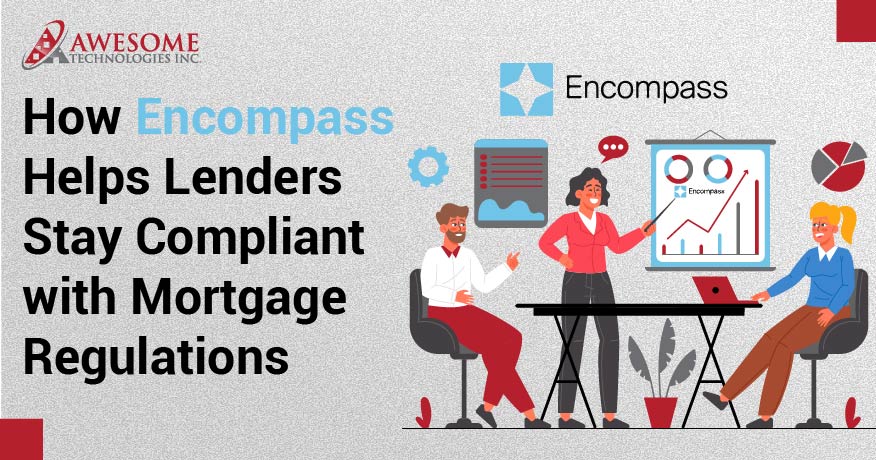
Mortgage lending has lots of regulations from the federal government, state governments and from the investors who buy the loans. Lenders must strictly adhere to this to be able to lend mortgage money and keep their business.
Today, it is almost impossible to keep track of the constantly changing regulations by hand. If a lender makes even a minor mistake, there can be severe consequences.
Given that manual processes are slow, it is very easy to make mistakes because of manual errors. To resolve this issue, Encompass Loan Origination System (LOS) builds compliance into the daily process of mortgage origination.
Rather than checking the file at the end of the process for mistakes, the LOS uses automated business rules to validate all critical requirements.
As an example, the LOS automatically prepares all disclosures, re-verifies all data, and creates a complete audit trail.
Through the use of Encompass compliance tools, the lender is sure that every loan originated is “clean” and compliant before it goes to closing.
Why Compliance is Harder Today?
- Too Many Rules: Regulators’ periodic revisions of existing regulations can make compliance a confusing and complicated process.
- Human Error: Manually entering information can lead to errors.
- Greater Costs of Compliance: Correcting compliance errors made after loan closing will be much more expensive than preventing the errors at the beginning of the loan.
How Technology Helps Mortgage Compliance Automation?
| Features | What Does It Do? |
| Auto-Disclosures | Sends the right legal papers to the borrower automatically. |
| Validation Rules | Stops a user from moving forward if a required field is wrong or gone missing. |
| Audit Trails | Keeps a digital receipt of every action to prove that the rules were followed. |
Why Lending Compliance Management Is Critical for Lenders?
Complying with regulations helps to ensure the longevity of any business.
There are huge financial consequences for a lender when they violate regulation. It is because CFPB can penalize lenders with millions of dollars in fines. Also, when a loan is not done correctly, an investor may choose not to purchase the loan.
The combination of these two situations can lead to large operational losses. So, why not believe that mortgage compliance management is the right solution?
There are great operational risks related to non-compliance. As non-compliance creates “bottlenecks”, it may take longer for a loan to be closed.
A high volume of mistakes may result in the lender attracting the attention of a regulatory agency who will conduct an audit.
Smart lenders look at compliance as a tool for creating a competitive advantage. They can achieve the following through the use of automated processes:
- Faster loan approval processes allow movement through the lending process.
- There are fewer errors due to units catching small typos.
- The lender’s reputation improves as borrowers and partners have confidence that a lender will do it right the first time.
Comparison: Manual vs. Automated Compliance
| Manual Compliance | Automated Compliance |
| High chance of human error. | The system catches errors instantly. |
| Slow, paper-heavy process. | Fast, digital workflow. |
| Stressful audits. | Easy “one-click” audit reports. |
Critical Data: The Cost of Getting it Wrong
To emphasize why this technology is vital, consider these industry benchmarks for 2025–2026:
| Category | Manual Process Cost | Encompass Automated Cost |
| Cost to Originate | ~$12,000+ per loan | ~$9,500 – $10,500 per loan |
| Error Rate | 5-8% of files | <1.5% of files |
| Audit Prep Time | 2-3 weeks | 2-3 days |
Benefits of Compliance Automation in Mortgage Lending
| Feature | How Does It Ensure Compliance? |
| Built-in Compliance Checks | Encompass’s built-in compliance engine will check loan information for compliance in real-time. It will automatically identify any wrong information or missing data and inform the team via alerts. |
| Automatic Disclosures | The Encompass system also tracks these critical timeframes to ensure that all disclosures are sent out on-time. |
| Support for Multiple Regulations | The Encompass platform contains the necessary information needed to assist lenders to remain compliant with TRID, HMDA, TILA, RESPA, ECOA, and ATR/QM. |
| Easy Regulatory Reporting | Collects required loan information and preparing compliance reports. |
| Workflow and Audit Tracking | The Encompass system will guide loans through each of their various processes and provide the lender with a complete audit trail. |
The Mortgage Regulations Lenders Must Follow
Mortgage lenders must follow many strict federal regulations when processing, disclosing, and reporting on loans.
These regulations protect consumers, allow borrowers access to all of the information they need to confidently agree to a loan.
Because of this environment, lenders must follow regulatory compliance frameworks in every phase of the loan process to cope with lending compliance management.
TRID (TILA-RESPA Integrated Disclosure)
The TRID regulations require lenders to provide two key disclosures. The first disclosure is called the Loan Estimate. Lenders must provide each applicant with an estimate of the costs within three business days of applying.
The second disclosure is called the Closing Disclosure. Lenders must provide each borrower with a final detailed description of their loan in the form of a Closing Statement.
Both of these disclosures ensure that borrowers fully understand their financial obligations before they commit to a loan.
HMDA (Home Mortgage Disclosure Act)
Under HMDA, lenders must comply with regulations that require them to disclose some information about loans.
Reporting is divided into two types: demographic reports and regulatory reports.
Demographic reports include information such as the borrower’s race, gender, and ethnicity. The regulatory report helps regulators assess whether the mortgage industry is practicing fair and equal lending.
- Denial Rates: Black and Hispanic applicants have historically experienced higher denial rates (on average 15-20% higher) compared to white borrowers for the same loan products.
- The Encompass Role: The automated rate spread calculation and Fair Lending Dashboards provide lenders the ability to view their lending patterns in real-time and correct for “unintentional bias” in their underwriting algorithms.
ECOA and Fair Lending Regulations
A lender may not discriminate against applicants for loans based on their race, gender, age or marital status.
RESPA (Real Estate Settlement Procedures Act)
Under RESPA, lenders are required to disclose all costs associated with the closing process. The law also prohibits paying a bribe or inside commission to a service provider.
ATR/QM Rules
Lenders must prove that they checked a borrower’s ability to repay before granting permission for a mortgage according to the Ability-to-Repay and Qualified Mortgages regulations.
To ease the compliance burden, today’s mortgage compliance software has built in compliance checks and workflows.
What Is Encompass Mortgage Software?
Encompass is a LOS, developed by ICE Mortgage Technology. It is used by banks, credit unions, and mortgage companies to manage their loan files, keep track of their progress, and correctly complete the mortgage application process.
It supports the entire loan lifecycle, from loan application through underwriting and through final loan closing.
The Encompass system has many robust features, including a built-in compliance engine. It also has advanced workflow automation that simplifies the loan application process while reducing manual labour.
How Does Encompass Automate Conditions?
Conditions exist as digital tasks that live in the eFolder for each loan and are managed through tasks within the eFolder.
- Automated Triggers: Automatically create conditions based on the type of loan you have.
- Connection to eFolder: When your borrower uploads a document, the Encompass system will automatically connect that document to any condition it fulfills.
- Role-Based Clearing: You can specify rules for which users. This eliminates the possibility of accidental approval and keeps all the guardrails up.
- Enhanced Conditions (2026 Update): The latest version of Encompass allows for “Enhanced Conditions,” to better track conditions, store internal notes, and maintain a clear audit trail.
The Compliance Connection
| Manual Conditions | Encompass Automated Conditions |
| Underwriters forget to add required state-specific forms. | The system automatically adds “hard-stop” conditions based on property state. |
| Processors might miss a signature on a trailing doc. | The system flags the condition as “Incomplete” until the eSignature is verified. |
| No proof of who reviewed the income docs. | The audit trail shows exactly which user cleared the condition and when. |
Automated Disclosure Management (TRID Compliance)
Mortgage lenders are subject to government regulation with deadlines for obtaining signed disclosure.
Encompass provides lenders with comprehensive automated tools so that lenders can comply with TRID regulations and streamline manual tasks.
-
Automatic Generation of Loan Estimate
Encompass enables lenders to produce Standard Loan Estimates at the point an applicant submits their loan application.
The Loan Estimate document will contain all estimated costs, interest rates and monthly payments in a standardized format.
-
Automated Closing Disclosure Creation
After the applicant’s loan progresses to the closing stage of processing, Encompass will produce the Closing Document.
Encompass utilizes verified information from the loan file to create the Closing Document so the borrower and lender will have the same information.
-
Disclosure Timing Controls
Encompass will track the regulatory timetable and will also automatically produce lender disclosures when the loan reaches a certain milestone. Mortgage regulatory compliance will ensure that lenders do not lose track of critical timeliness.
HMDA Compliance and Reporting Automation
To help relieve the burden of HMDA reporting on lenders, Encompass facilitates all aspects of HMDA compliance through automation in the loans origination system.
-
Automated Data Collection for HMDA
Encompass will automatically capture all required HMDA data during the loan application process. The data includes borrower demographic information and the various loan attributes required.
-
HMDA Edit Checks
Utilizing automated edit checks, the system will check for completeness, formatting, or inconsistencies of data before HMDA reports are even submitted to regulators.
This type of automated data editing will help lenders identify and correct discrepancies before submitting their loan information to the appropriate regulatory agency.
-
Automated Rate Spread Calculation
Encompass will also perform the loan rate spread calculations necessary for certain HMDA reporting categories. Compliance tools streamline the process.
Data Validation and Error Prevention Tools
In terms of improving loan data quality and preventing errors in reporting, Encompass has provided several tools for this purpose.
Address Validation
One of the recent updates within Encompass is the ability to validate property addresses against the USPS, as well as to standardize the address format to match the format provided by the USPS.
This helps to reduce any discrepancies between the address reported and the address associated with an address that is reported on a regulatory report or loan document.
Automated Data Standardization
Encompass automatically standardizes borrower’s and loans’ data-entry fields via formatting to ensure that data is consistently entered in the system to reduce the likelihood of making manual-entry errors.
Due to the manner in which borrower and loan data entry is standardized, it allows for the same type of loan information to be entered in the same way across the platform.
Early Loan Data Verification
At the beginning of the mortgage application process, a lender uses a digital platform to verify data associated with the loan, so that they can verify and correct that data if necessary.
Early detection allows for the correction of any errors prior to the underwriting of a loan and/or compliance reporting.
The use of electronic tools for validating the information helps to improve the accuracy of loan data and the quality of the reporting of this information.
At the same time, digital mortgage compliance ensures that the lenders provide regulatory compliance requirements, which is especially important to large lenders with a high volume of loans.
Document Management and Compliance Tracking
Mortgage lending requires lenders to manage large volumes of documentation securely and have them easily accessible for compliance audits.
Lenders can use Encompass document management tools to arrange their documents and keep their records in compliance.
-
Centralized Document Storage
The Encompass software enables all loan-related documents to be stored in one centralized place.
Therefore, loan officers, processors, and compliance teams can all access borrower documents from one location, reducing the risk of misplaced documents.
-
Compliance-Ready Document Templates
Encompass also provides federally compliant documents by having a complete library of state and federal compliant document templates.
Therefore, lenders can produce compliant loan closing documents without having to worry about formatting or applicable disclosures.
-
Digital Signature and eClosing
Mortgage compliance software provides both digital signature capabilities as well as eClosing capabilities.
This means that borrowers can electronically review, sign, and complete their loan closing by using an electronic signature.
By providing centralized document storage, compliant templates, and digital signatures, Encompass ensures that lenders have accurate and complete documentation.
Automated Document Expiration Monitoring
Many documents that the borrower provides (income, credit, ID) come with expiration dates.
Therefore, if the loan file contains any expired documents, the lender can experience problems with compliance or delays in the underwriting process.
Encompass has tools available to lenders to help them track the risk of document expiration.
The system tracks the timeline of all documents, and alerts the loan officer prior to the expiration of the file.
Automated expiration monitoring will also assist the lender in the underwriting review, because it will ensure that all required borrower documentation is valid throughout the loan process.
Workflow Automation That Enforces Compliance
Compliance is an ever-changing and challenging issue for all lenders.
Encompass gives lenders the tools they need to fulfill their regulatory obligations by integrating compliance requirements directly into automated loan processes.
With these automated processes of mortgage regulatory compliance and workflow automation, lending professionals can reduce manual errors while completing a loan.
-
Rule-Based Workflow Engine
The Encompass Business Rules Workflow Engine contains a comprehensive rules application engine that applies compliance rules to the different loan process workflows.
Compliance rules applied at various stages of the loan process guarantee that all necessary actions, disclosures, and validations have occurred at the time a loan is ready for processing.
Many lenders nowadays are making use of Encompass customization services to build workflows and improve compliance. Workflows created through these services help lenders to create automatic rules, create alerts, generate reports tailored to individual lender’s own operational needs and compliance requirements!
-
Task Automation
The workflow will also automatically generate assignments and compliance checkpoints for all tasks in the workflow.
For example, a verification of documents or delivery of disclosures would be required before allowing a loan to proceed to underwriting.
-
Milestone Tracking
Each loan will move through identified milestones in the loan workflow, and the lending compliance management system will keep track of each milestone.
Automation is also accomplished via business rule engines within Encompass, which automate repetitive compliance testing and allow lenders to process their loans more quickly.
Audit Trails and Compliance Monitoring
Lenders need to demonstrate, via regulatory audits, that they have processed their loan files in accordance with compliance rules.
Encompass compliance tools enable lenders to track their activities and maintain audit-ready records of what they have done.
-
Complete Loan File History
The platform records a complete loan file activity history. It allows lenders to show how a loan was originated and processed.
-
Compliance Dashboards
Encompass has compliance dashboards that allow real-time visibility into compliance performance. Compliance teams can track risk indicators, track regulatory metrics and identify problems throughout their loan portfolio.
-
Exception Management
When compliance rules are not met or exceptions occur, the system automatically flags the exception for review. The compliance team is then able to investigate and resolve exceptions before regulatory reporting or audits.
These monitoring tools enable lenders to maintain complete and accurate records and provide documentation for regulatory examinations.
AI and Predictive Compliance Monitoring
Artificial intelligence is becoming more prevalent as it relates to the identification of risk through the detection of compliance issues, as well as regulatory compliance monitoring.
The Encompass platforms now being utilized by today’s mortgage origination teams have begun to incorporate the use of AI-based solutions.
Additionally, AI will enable compliance assistants to assist compliance officers in reviewing loan files and highlighting compliance issues, as well as providing recommendations to assist loan officers in resolving such compliance issues.
Predictive analytics using AI can also help lenders identify patterns that may indicate regulatory risk and underwriting concerns.
As compliance technologies evolve and mature, AI-based digital mortgage compliance will improve the quality of audits and decrease the regulatory inquiries.
Third-Party Compliance Integrations
Encompass can integrate with other compliance system software to include compliance solutions.
-
Compliance Analytics Tools
RiskExec and Wolters Kluwer are compliance analytic tools that that work with Encompass to allow lenders to analyze their lending practices, assess their exposure to regulatory risk, and produce complex compliance reports.
-
Fraud Detection Platforms
Third-Party Fraud Detection tools can be used alongside with Encompass to help lenders identify possibly fraudulent loan activity.
-
Regulatory Reporting Platforms
Compliance Reporting tools that work with Encompass can automate certain regulatory reporting mortgage processes.
This combination of integrations give lenders the ability to build a much more robust compliance infrastructure while keeping their loan data secure in Encompass.
Compliance Best Practices for Encompass Users
Lenders can take advantage of many beneficial compliance features with Encompass by properly establishing and administering their configurations.
1) All compliance rules are based on both federal and state regulation requirements, so lenders need to make sure they have configured their system’s settings properly.
2) Lenders must also conduct periodic internal compliance audits to ensure that their loan workflows and disclosure processes comply with regulatory standards.
3) Training for loan officers and processors is critical, as they need to know how Encompass’s compliance tools work in order to properly respond to alerts and warnings.
4) Compliance teams must consistently monitor dashboards and reporting tools to identify risk indicators for potential issues as early as possible.
When lenders follow these best practices, they create an efficient compliance framework and leverage the full benefits of the Encompass platform.
To ensure your lending operations remain fully compliant and optimized, explore our Encompass compliance services and take the next step toward smarter, risk-free mortgage processing.
To Conclude: Why Encompass is a Compliance Backbone for Mortgage Lenders?
Mortgage lenders need to navigate complicated regulations which they must satisfy while working to process loan applications. It operates as a compliance foundation.
Encompass uses its internal compliance engine to conduct ongoing rule assessments which enable lenders to discover mistakes and stop future violations.
At Awesome Technologies Inc., our mortgage compliance software streamlines regulatory reporting by collecting essential loan information. We have a team of experts that leverages the software to enforce workflow compliance and maintain comprehensive audit monitoring.
Final takeaway: The Encompass system provides lenders with tools to handle complex regulatory demands while they preserve their ability to operate and grow their business. Let’s connect to avail the best of digital mortgage compliance!
FAQs
1. Is Encompass suitable for small lenders?
Absolutely! Small lenders can use the automation features and compliance tools provided by Encompass to help their small teams manage loans in a more efficient manner.
2. How Do Lenders Customize Encompass Compliance Rules?
It allows lenders to customize the rules set for their required documentation, disclosures and data fields based on loan types or applicable regulatory guidelines.
3. Why Do Lenders Choose Encompass Consulting?
An Encompass consultant will assist the lender in configuring workflows, compliance rules and interfaces to enhance overall loan production.