
For mortgage lenders, accurate data is very important to make timely decisions, be compliant with regulations, and give their customers a pleasant borrower experience. But if loan data is stored in multiple locations (such as spreadsheets, CRMs, legacy systems, and loan origination systems), errors due to duplicate records may happen.
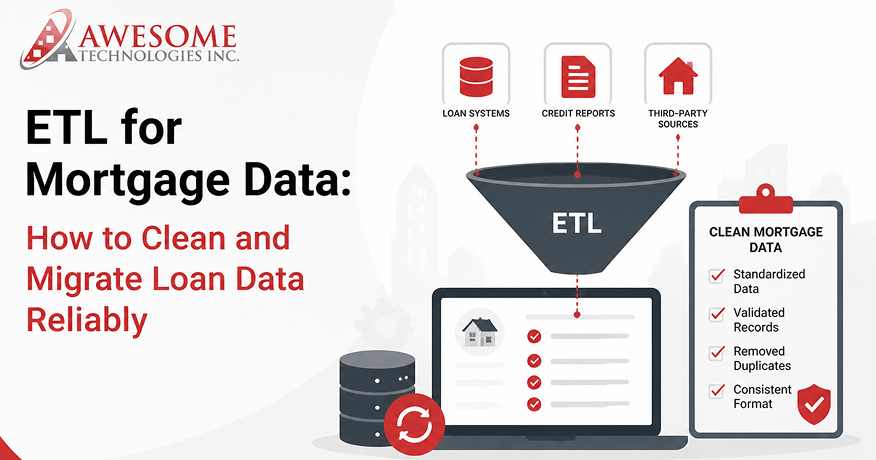
Many lenders opted for ETL processes as a means of correcting this situation. The ETL process gathers all different sources of data, clean the data, organize it, and check it for errors. This data can then be used in new systems without interfering with day-to-day operations.
This blog will address how ETL improves the quality of mortgage data, decreases the reporting errors, and improves the migration process. Hence, resulting in greater efficiencies and compliance.
What is ETL in Mortgage Data Processing?
ETL stands for Extract, Transform, Load. It is a process to move data from one source to another, while ensuring that it is usable, clean and consistent. ETL supports the data migration and synchronization components of LOS migrations, compliance reporting, analytics, and third-party integrations. Overall, ETL process for mortgage lenders provides the data pipeline layer for all of these activities occurring within mortgage lending.
To get an overall understanding of ETL for mortgage data and its use throughout the scope of mortgage lending, we can define it in the following way:
- Extract – It is the act of taking out data from a loan system, such as borrower information, income documentation, appraisals, etc. Then collect this data from the old loan system for migration into a new loan system.
- Transform – Making the loan data usable by cleaning it up and organizing it into an order that can be easily interpreted or processed by other applications. You will fix any formatting issues, remove duplicate loans, identify the linkage between loan fields, calculate income, and check that you are in compliance with lending laws.
- Load – Move your cleaned and processed loan data into the new loan system so that it can be used without any problems.
This showcases that ETL has moved off of IT backlogs and instead onto the agenda for discussions among company leadership teams. The potential costs of failure, including compliance fines, audit failures, or lost borrower trust, greatly overshadow what it will cost to do ETL correctly.
Why Loan Data Quality Breaks Down Before It Even Reaches Your Warehouse?
Mortgage ecosystems contain a mix of structured, semi-structured, and unstructured data. A single mortgage loan file can range in size from several hundred to several thousand pages with 1003 applications, W-2s, paystubs, bank statements, tax returns, appraisals, purchase contracts, and other regulatory disclosures. All of these documents have completely different fields, date formats, and formats. Additionally, as mortgage loan data moves through various systems (POS > LOS > Servicing), more disruptions come along the way.
The MISMO standards have a tremendous impact on the ability of various mortgage parties to communicate through the standardization of the delivery of loan data to/from POS, LOS, servicing, investor and secondary market participants. The legacy loan data delivered through ETL pipelines often conforms to MISMO guidelines. Later, it was converted into MISMO-compliant formats. The purpose is to improve consistency throughout the modern mortgage landscape.
Mortgage companies have collected huge amounts of data in many years. There are loan files going back as far as 2004, email archives from loan processing personnel dating back to 2012 and duplicate record files from systems that were merged back in 2017 existing across many different systems today. Migrating all of this data to a new environment is like filling a fleet of moving vans with all of your storage and warehouse goods without knowing what is in each box!
–Mortgage Workspace, “Migration Myths Busted: What You Need to Know About Moving Mortgage Data Seamlessly” (2025)
What Goes Wrong?
- Borrowers with duplicate records as a result of merging multiple LOS systems
- Variations in the way Social Security Numbers (SSNs) are represented across historical records
- Missing or blank entries in HMDA required fields Date formats that combine MM/DD/YYYY and YYYY-MM-DD
- Loan amounts represented as text in one system and as numbers in a different system
- Field names in legacy systems that don’t easily transfer to a new database design
- Significant numbers of encoding errors in scanned document Optical Character Recognition (OCR) output
What Extract Transform Load Mortgage Fixes?
- De-duplication based on Social Security Numbers (SSNs) and loan numbers combined
- Standardization of SSN masking and formatting procedures on an enterprise-wide basis
- Normalize dates into a canonical ISO 8601 format within the transformation layer.
- Provide visual mapping tools for variable alignment between legacy and target fields
- OCR outputs can be validated using confidence scoring models and human review workflows
Compared to most other industries, financial data has higher compliance risk, larger number of redundant systems, and much greater costs linked with errors.
The ETL Pipeline for Mortgage Data Migration: Extract, Transform and Load
Let’s walk through what a production-grade mortgage ETL pipeline actually looks like, from source system to target warehouse:
The Staging Layer — The Most Overlooked Step
Not having a staging layer as part of your ETL process for transforming mortgage data is a serious mistake. A staging layer in ETL process for mortgage lenders allows:
- To see a complete and accurate copy of your source data before any transformations occur.
- To easily run your data transformations again without needing to extract your source data again.
- To revert to a previous state if your transformation rule produces an unexpected result.
Change Data Capture (CDC) vs. Full Loads
You do not typically want to reload all of your loan records on a daily basis. Change Data Capture (CDC) captures the changes to the records since they were last processed which only processes these deltas. This will reduce the amount of time it takes to run a pipeline from hours to minutes. Also, it minimizes the risk of overwriting accurate data with inaccurate and/or stale full load snapshots.
7 Types of Dirty Mortgage Data and How To Clean Each One
The following are the seven most common data quality issues found in mortgage pipelines along with their solutions.
| Data Problem | Where It Comes From | ETL Fix | Severity |
| Duplicate Borrower Records | Merging two LOS, re-enter data in a different operating system, using different types of databases, and running both systems at one time. | Hashed SSN/tokenized SSN + DOB + normalized borrower name | Critical |
| Inconsistent Data Records | Working with different LOS versions and importing from those LOS versions manually. | Converting to ISO 8601 (YYYY – MM – DD) format during transformation. | High |
| Null HMDA Required Fields | Incomplete applications, not having fields in the existing computer systems capacity. | Required-field validation rules with exception and rejection logging. | Critical |
| Loan Amount Type Mismatch | Field Types Changing based on the different LOS Versions. | Explicit data type casting and numeric boundary validation. | High |
| OCR Extraction Errors | 1003 Loan Applications and scanned pay stubs submitted by hand. | AI Confidence Scoring + Human in the Loop Review Queue | High |
| Legacy Field Name Mismatches | Migration from other LOS Vendor systems to another (Encompass data migration to BytePro). | Visuals and mapping tables assist with field alignment during migration. | High |
Loan Data Migration Checklist: What to Validate Before You Go Live?
- Checksum Validation: Row-level or table-level checksum validation across critical fields are used to determine if data has been corrupted without any record of it happening.
- Referential Integrity: Each loan’s record must contain a valid borrower ID, property record, and loan officer record. If a loan doesn’t contain these, it will fail referential integrity.
- HMDA Field Completeness: All applicable HMDA LAR fields need to be populated for reportable loans. Missing fields are an issue.
- Date Consistency: The date of application must occur before the date of closing and the date of closing must occur before the date of the first payment.
- Loan Amount Sanity Checks: Configurable loan amount threshold checks or over conforming limits. Checks for numeric overflow due to type cast errors.
- PII Masking Confirmation: Confirmation of PII (personal identifiable information) masking, including SSN (social security number), date of birth, and previous income must be encrypted during testing.
- Rollback Plan Tested: You must perform a complete rollback drill for your staging environment before you can go into production.
- Parallel Run Sign-Off: There must be a parallel run of the old and new systems for at least 5 business days. Daily loan counts, statuses and dollar amounts must match between both systems.
ETL Tools Compared For Mortgage Data Pipelines
Not every ETL tool for banking is built with mortgage-specific needs. Here is how the major players stack up against the needs of a mid-to-large lender.
| Tool | Best For | Mortgage Relevant Features | Deployment | Starting Costs |
| Informatica IDMC | Migration from legacy systems to an enterprise-scale solution (FSC, LOS) | Using data mapping for loan migration, visualizing fields, lineage tracking etc | Cloud/Hybrid | Custom (Enterprise) |
| Advanced ETL Processor | Must be self-hosted by lenders who require more stringent compliance | LOS/CRM/ERP connectors; AI used to detect anomalies; self-hosted security; HMDA Validation Rules | On-premise (Windows) | $690 one-time |
| Talend Data Integration | Gather mortgage data from multiple sources | 100+ native connectors; Data quality module; Schema drift detection | Cloud / On-premise | ~$1,170/mo |
| Matillion | Cloud-native LOS-to-Warehouse Pipelines | AI assisted (Maia); Using Snowflake/Redshift natively; CDC support; No-code transforms | Cloud-native | Consumption-based |
| Apache NiFi | Routing of high-volume, real-time data | Flow-based programming; Back-pressure handling; Provenance tracking for audit requirements | On-premise / Cloud | Open source |
| Azure Data Factory | Microsoft stack lenders: (Azure SQL, Dynamics) | 250+ connectors; Pipeline orchestration; Integrated with Synapse analytics | Azure Cloud | Pay-per-use |
Self-Hosted vs. Cloud ETL: The Mortgage-Specific Trade-Off
In the case of mortgage lenders, it’s not just about cost or convenience, it’s also about compliance and security. Mortgage data contains PII, income, SSNs, and credit history that fall under GLBA (Gramm-Leach-Bliley Act), FCRA (Fair Credit Reporting Act) and state privacy laws. With an on-prem ETL solution, you can keep that data in your own infrastructure, behind your firewall, and you control the access to that data.
While Cloud ETL offers faster deployment and less cost, it requires entering into a Data Processing Agreement (DPA) or equivalent processing agreement along with ensuring that your organization has properly configured the Data Residency.
The right choice depends on the regulatory position of the organization, the technical capabilities of its information systems personnel, and its volume of loans
Compliance in Motion: RESPA, HMDA and TRID Data Integrity Rules
Regulators want, need, and will expect you to validate your data with documented evidence of validated records, audit trails, and lineage. ETL Pipelines that take compliance into account will make it easy to audit those records, defend those audits, and do so with little or no impact to other business processes.
HMDA (Home Mortgage Disclosure Act)
The Home Mortgage Disclosure Act requires lenders to collect various data fields on each loan application, including information about the borrower (demographics), property, loan terms, and action taken. Before loan application registers (LARs) are submitted to the CFPB for compliance with the HMDA, ETL pipelines need to verify that all of the 48 fields are complete. Example of common ETL rules include:
- Reject record if there are any required fields that have a null value.
- Validate the race and ethnicity codes against the CFPB’s approved enumeration code list.
- Flagging Loan Applications with an action taken date prior to the date of application.
- Validating that property census tract codes are valid 11-digit FIPS codes.
TRID (TILA-RESPA Integrated Disclosure)
ETL pipelines should support TRID timing and fee-tolerance validation requirements. The ETL processes must also compare loan closing document fees disclosed on the loan closing documents with the actual costs of closing the transaction.
Data Lineage: The Hidden Compliance Requirement
When it comes to compliance with regulators, it’s important only to understand what the data is, but also to be able to identify the source and the manner in which that data was changed.
ETL Tools such as Apache Atlas and Informatica, have the ability to provide visual lineage graphing with their tools and thus can aid in completing this effort. However, because of the complexity of the transformation, you should log every step of the transformation to an immutable Audit Log.
Regulatory Note: Audit logs of your ETL should correlate directly to organizational cybersecurity governance frameworks such as NIST CSF 2.0.
5 Migration Mistakes Lenders Make During LOS Migration
Following an analysis of many mortgage data migration initiatives, we have identified 5 of the most frequent (and most costly) reasons that resulted in unsuccessful migrations.
Mistake 1: Migrating dirty data “as-is” and planning to clean it later
The most dangerous expression in a migration project is “we’ll clean it up after we go-live.” Data quality problems get worse during the migration to the new environment. Duplicated records cause additional duplicated records to be created when they are processed through the new system. Records that contain errors in the HMDA field will cause loan applications to be rejected, requiring the loan application to be corrected by a loan originator. Therefore, it is important to clean your data in the ETL process before migrating the data into your new system.
Mistake 2: No parallel run period
Lenders that have migrated to a new LOS on Monday, without running both systems parallel for at least one week, often find out their field mapping is incorrect after underwriters have worked 200 loans in new LOS. A parallel run for 5-10 business days is minimum for a successful migration of any production mortgage system.
Mistake 3: Underestimating legacy data volume
Lenders often do not consider the volume of historical data that will be migrated in a typical mortgage migration. This creates a problem because lenders need to be able to search for closed loans from ten years ago when doing QC audits, and they still need to have access to archived condition documents if they are going to do a secondary market review. The primary reason why mortgage migrations end up taking longer and going over budget is due to an increase in data volume (i.e., scope creep).
Mistake 4: No rollback plan
Migrating without a rollback plan that has been tested is like rolling the dice. ETL pipelines should be designed so that the source system is left in place until the target system has been confirmed to work properly. This means that no changes or deletions to the source database will take place until after both the parallel run period has concluded and executive sign-off has been received.
Mistake 5: Treating ETL as a one-time project
Mortgage data is constantly changing. New loan transactions are processed every day, servicing records are updated on a regular basis, and regulations could change at any moment. The ETL pipeline you will use to migrate your historical data on migration day will need to continue on an ongoing basis. Think about how you will create a seamless operation from day 1.
Best Practices For Reliable Mortgage ETL in 2026
| Maturity Level | What It Looks Like | Data Quality | Compliance Posture |
| Level 1: Manual | Manual re-entry of data through between different systems via spreadsheet exports | Poor | Reactive |
| Level 2: Scripted | Custom SQL scripts or python jobs run on a scheduled basis. | Moderate | Inconsistent |
| Level 3: Automated ETL | A dedicated ETL platform for visual mapping and scheduling. | Good | Documented |
| Level 4: Governed ETL | Complete lineage, automated HMDA validation, change data capture (CDC) pipeline, and anomaly detection. | Excellent | Audit-ready |
In Level 3 and Level 4 mortgage data operations, the following are practices that differ from other Level 1 and Level 2 operations:
- Profile before you pipeline: You must profile an incoming source to determine null rates, unique value distributions, and many different types of date formats before writing any transformation rules. Profiling identifies 80% of the issues you will face in a production environment prior to them hitting production.
- Use composite keys for mortgage records: Using just a loan number for uniquely identifying records across systems is not a reliable means of achieving this. A standard means for achieving a canonical record ID during migration is to use a composite of loan number + origination date + borrower SSN (masked).
- Separate PII handling from business logic: PII processing should be handled in a separate transformation layer (i.e., masking, tokenization, encryption) from business logic transformations. This ensures making auditing easier, as well as allowing for independent changes.
- Automate HMDA pre-validation: As part of your ETL pipeline, run the CFPB’s HMDA Platform edit checks. Do not run these as part of a post-load processing step. It will cost you less to identify LAR errors in the pipeline than to resolve them during a regulatory submission process.
- Version your transformation logic: Every ETL mapping, business rule, and validation should be versioned in source control along with the application code. If a regulator asks for the logic behind how a particular field was transformed for Q3 2023, you will want to be able to provide a git commit instead of a verbal response.
- Monitor pipelines with SLAs: If your mortgage ETL pipeline goes down at 2 AM, that is far worse than simply not having a pipeline. Set up alerts for record count anomalies, pipeline duration outliers, and spikes in field null rates, and treat your data pipeline’s reliability like system uptime.
In Conclusion
Operating under the belief that the ETL process is purely a technical problem misses the audience of mortgage operations. Mortgage lenders that successfully implement ETL best practices generally enjoy lower loan costs, are easily able to pass HMDA audits, and can move to new systems without losing loan files.
The infrastructure for efficient ETL is not complex but very detailed. It needs to be created in stages, validated at every step along the way, have the source retained until the target has been verified to be correct, have your transformational rules versioned and be constantly monitored.
It’s the perfect opportunity for your organization to implement an ETL process that has scalability, compliance, and operational efficiency in mind, even if you are currently migrating LOS, improving accuracy of HMDA reports or experiencing challenges with inconsistent loan data. A well-structured ETL framework also supports more reliable mortgage data integration across systems and departments.
If you haven’t partnered with mortgage technology specialists yet, do so soon and Awesome Technologies Inc. will help you clean, migrate and maintain your loan data confidently. Learn how ETL tools for data warehousing support enhance centralized reporting capabilities and improve cross-system data synchronization for analytics compliance visibility! Talk to an expert now!
FAQs
1. How long does mortgage data migration take?
A standard migration will take approximately 3-6 months from start to finish. For example, a mid-size lender with 50,000-200,000 historical loans will typically require 4-6 weeks for data profiling/mapping, 6-10 weeks for ETL development/testing, 2-3 weeks for performing the parallel run, and 1-2 weeks for cutover and stabilization. Companies who do not perform a parallel run will often see their 3 month project turn into a 12 month project.
2. Can we migrate data while the LOS is live?
Yes, if you have CDC (Change Data Capture) enabled, you can move historical data into the new LOS in batches while you continue operating the old LOS. The CDC layer will capture every change made during the migration process to help you capture those changes and apply those changes to the new LOS. This is the standard way of doing zero-downtime migrations in production mortgage environments.
3. What is the difference between ETL and ELT for mortgage data?
The difference between ETL and ELT with regard to mortgage data is primarily how the data is transformed: In the traditional ETL model, the data is first transformed prior to being loaded in the target system. Whereas within ELT, the data is ingested into the target data warehouse in its raw format and is transformed afterwards within the data warehouse using SQL. ].
4. How do we handle PII during ETL testing?
In all cases, do not use real borrower data in any non-production ETL test environments. So, create synthetic data that copies your production schema. However, the social security numbers (SSNs), names and income amounts will be created using fake data generation methods. There are tools that can be used to generate these types of realistic synthetic mortgage data sets for use in testing. Examples of such tools include Faker (Python), Mockaroo and data masking functionally built into Informatica and Talend.
5. What are the HMDA consequences of a bad ETL migration?
CFPB examiners who discover systemic HMDA data errors may require a complete resubmission of the LAR, civil money penalties and flagging the institution for additional supervisory oversight.